
Online Giving Platforms for Churches: A 2026 Guide
Online giving platforms for churches compared: the three types, real fees, must-have features, and how to add giving to your own church website in 2026.
- Online giving platforms for churches let members donate digitally through your site, a text, or an app, handling recurring gifts, fund designations, and processing.
- They come in three types: dedicated church platforms like Tithe.ly and Pushpay, general processors like Stripe and PayPal, and giving built into your own website.
- Most charge 2.2% to 3% plus a small per-transaction fee, and some add a monthly or platform fee, so compare the all-in cost, not the headline rate.
- Recurring, automatic giving is the single biggest lever, and giving hosted on your own site earns more member trust than a third-party page.
What are online giving platforms for churches?
Online giving platforms for churches are the tools that let members donate digitally, through your website, a text message, or an app, instead of only cash or check in the plate. They handle the giving form, the recurring schedules, the fund designations, and the payment processing behind it all.
As fewer people carry cash or a checkbook, the offering plate captures less of what a congregation actually intends to give. Online giving closes that gap by meeting members where they already are, on a phone, and letting them give in a few taps or set up a recurring gift once. The platforms differ mostly in where the giving lives and how much they charge, but they all do the same core job: turn a good intention into a completed gift with as little friction as possible. Getting that experience right is a real part of how we build a church website.
Why churches need online giving
Because most members no longer carry cash or checks, and recurring digital giving smooths out the ups and downs that make a church budget hard to plan. A church without online giving is quietly leaving support on the table every week.
Two things make online giving matter more each year. First, giving follows convenience: when it's easy to give from a phone, more members follow through on what they meant to give, including visitors and people who missed a Sunday. Second, recurring gifts steady the budget. A congregation that relies only on what's in the plate sees income swing with attendance, weather, and holidays, while a base of automatic monthly gifts holds firm through all of it. Online giving isn't about replacing the plate, it's about capturing the generosity that the plate alone now misses, and giving your leadership a more predictable foundation to plan from. There's a generational shift underneath this too. Younger members often don't own a checkbook at all, and they're used to paying for everything from a phone, so if giving to your church isn't just as easy, it simply won't happen, not because they don't want to give, but because the friction wins. Meeting that expectation isn't chasing a trend, it's removing a barrier that's quietly holding back people who already want to support the church's work.
The three types of church giving platforms
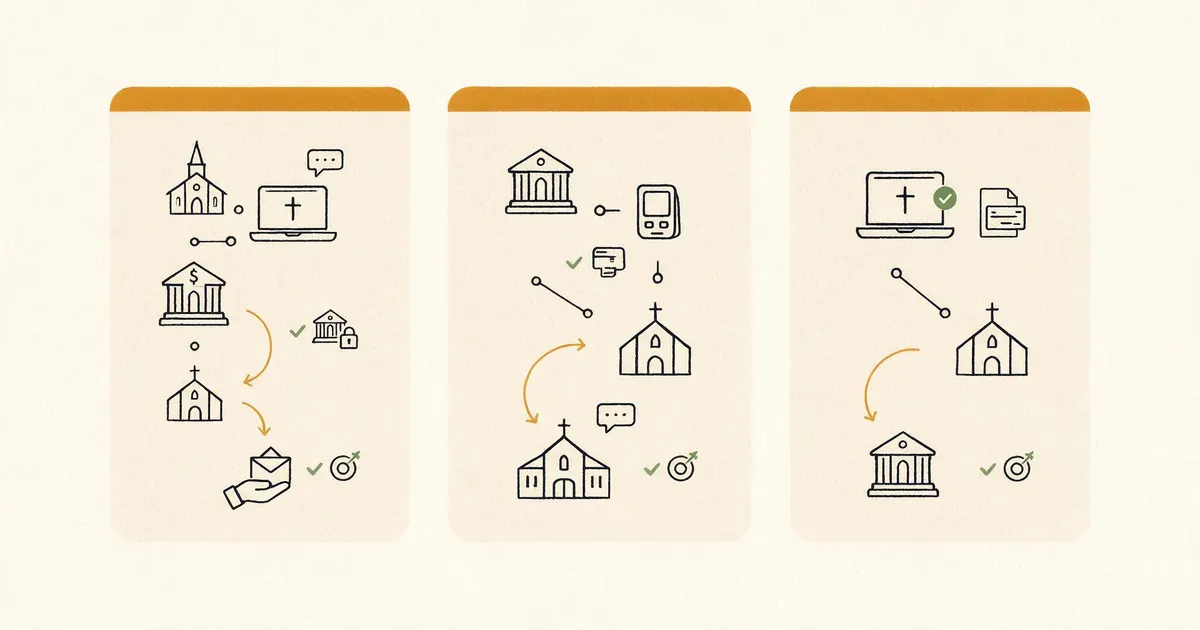
Church giving comes in three models: dedicated church-giving services, general payment processors, and giving built into your own website. Many churches combine them, and knowing the tradeoffs helps you weight the choice.
- Dedicated church platforms (Tithe.ly, Pushpay, and similar). Built for churches, with text-to-give, apps, and fund tools, usually at a higher all-in cost.
- General payment processors (Stripe, PayPal). Lower, simpler fees and broad trust, but fewer church-specific features out of the box.
- Giving built into your own website. A donation plugin or embedded processor on your church site, so members give without leaving your domain and the page matches your brand.
Features that actually matter
The features that move giving are recurring gifts, a fast mobile form, fund designation, and low fees, in that order. Everything else is a nice-to-have layered on top.
- Recurring giving. The single biggest lever, because it turns a weekly decision into a one-time setup that holds steady all year.
- A fast mobile form. Most gifts come from a phone, so a short, few-tap form with saved details captures gifts a long form would lose.
- Fund designation. Let members direct a gift to missions, building, or general fund, so the giving matches how your church accounts for it.
- Low, transparent fees and the option for donors to cover them, plus simple reporting for your treasurer and giving statements at year end.
Fees and real cost
Expect payment processing of roughly 2.2% to 3% plus a small per-transaction fee, and watch for monthly or platform fees that some dedicated services add on top. The all-in cost, not the headline rate, is what actually leaves your budget.
Card gifts cost more to process than bank-transfer (ACH) gifts, which is why many platforms nudge recurring givers toward ACH to keep fees down. Dedicated church platforms often layer a subscription or platform fee over the processing rate in exchange for their apps and features, while a plain processor like Stripe charges only the processing fee. Some platforms let donors add a little to cover the fee so the church receives the full gift, which many members happily do once asked. For a small or midsize church, the difference between a lean setup and a feature-heavy one can add up to real money over a year, so it pays to compare total cost against the features you'll actually use. A useful gut check: add up the monthly fees, the processing rate, and the per-gift charge at your real giving volume, then ask whether the extra features are worth that total. If they aren't, a simpler setup keeps more of every gift where it belongs.
Want giving that lives on your own site?
Free 45-minute call. We'll show you how to add low-fee, recurring giving to your church website that members actually trust. No pitch.
Adding giving to your church website
The most trusted setup puts giving directly on your own site through a donation plugin or an embedded processor like Stripe, so members never leave your domain. It's the difference between giving that feels like part of your church and giving that feels like a detour to a stranger's app.
On a WordPress church site, a giving page can carry your branding, sit one tap from the navigation, and process gifts securely without sending members to an unfamiliar third-party screen. That matters more than it sounds: people hesitate to enter card details on a page that doesn't look like the church they trust, and every hesitation costs a gift. Keeping giving on your own site also keeps the data and the member relationship with the church rather than a platform. This is exactly the kind of thing we handle when we build a church website or redesign an existing one, and it pairs naturally with the local visibility that helps new families find you in the first place.
How to choose the right platform
Match the platform to your size: a small church wins with low fees and simplicity, while a larger church may justify a full-featured platform with apps and analytics. Start simple and add features only when you actually need them.
For a smaller congregation, the priorities are low all-in fees, easy recurring giving, and a giving page on your own site that members trust, which a lean processor or a simple giving tool handles well. A larger church with staff, multiple funds, and a mobile app to run may get real value from a dedicated platform's deeper tools, even at a higher cost. The mistake either way is buying more platform than you need, or bolting giving onto a third-party page that feels disconnected from your church. Decide what your congregation actually needs, keep the fees honest, and put giving where members already trust you: on your own website. Done that way, online giving becomes a steady, dependable part of how your church is supported. And don't treat the launch as the finish line. The churches that see giving grow are the ones that keep mentioning it warmly from the front, make the recurring option obvious, and thank people for it, so it becomes a normal, expected part of church life rather than a button nobody notices. The platform gets you started, but it's the habit you build around it that makes online giving last.
Frequently asked questions about online giving platforms for churches
What are online giving platforms for churches?
Online giving platforms for churches are the tools that let members donate digitally, through your website, a text message, or an app, instead of only cash or check in the plate. They handle recurring gifts, one-time donations, fund designations like missions or building, and the payment processing behind it all. They come in three broad shapes: dedicated church-giving services like Tithe.ly and Pushpay, general payment processors like PayPal and Stripe, and giving built directly into your own church website. The right one depends on your size, budget, and how much you want the giving experience to live on your own site versus a third-party app.
How much do online giving platforms charge churches?
Most charge a payment-processing fee of roughly 2.2% to 3% plus a small per-transaction amount, and some dedicated church platforms add a monthly subscription or a platform fee on top. Card gifts usually cost more than bank-transfer (ACH) gifts, which is why many platforms encourage ACH for recurring giving. A few offer a way for donors to cover the fee so the church receives the full gift. Over a year, the difference between a low-fee setup and a high-fee one can be real money, so it's worth comparing the all-in cost, not just the headline rate.
What is the best online giving platform for a small church?
For a small church, the best platform is usually the one with the lowest all-in fees and the least overhead to run, which often means a simple, low-cost church-giving tool or a processor like Stripe embedded in your own website. Large platforms with rich apps and analytics can be overkill and cost more than a small congregation needs. The priorities for a smaller church are low fees, easy recurring giving, and a giving page that lives on your own site so members trust it. Start simple, keep fees low, and add features only when you actually need them.
Can I add online giving to my church WordPress website?
Yes. A WordPress church website can host giving directly through a donation plugin or an embedded processor like Stripe, so members give without leaving your site. This keeps the experience on your own domain, which members trust more than being sent to an unfamiliar third-party page, and it lets the giving page match your church's branding. You still use a payment processor behind the scenes, but the giving lives on your site rather than in someone else's app. It's the smoothest option for churches that want giving to feel like a natural part of their website.
How do I get church members to give online?
Make it easy and make it visible. Put a clear Give button in your website navigation and on your home page, offer recurring giving so members can set it once, and keep the giving form short, ideally a few taps on a phone. Beyond the tech, communicate it: mention online giving from the front, in the bulletin, and in emails, and reassure members it's secure. Recurring, automatic giving is the single biggest lever, because it turns a weekly decision into a one-time setup. The churches that see strong online giving treat it as a habit to build, not just a button to add.
Upcoming Brand | Church websites for Maryland and US-wide remote clients
We build church websites with low-fee online giving built in for congregations across Baltimore, Annapolis, Frederick, Rockville, and the US, delivered remotely via Zoom and async updates. Every build keeps giving on your own site, branded and trusted, with recurring gifts and fund designation, from a fixed-scope quote. Book a free discovery call or email hello@upcomingbrand.com.
Make giving simple for your members
Church websites with recurring, low-fee giving built right in: on your own domain, matched to your brand, and trusted by the people who give.