Most law firm websites lose clients before the first phone call: slow load times, missing schema, and copy that violates bar rules. We build WordPress sites for Maryland attorneys that pass Core Web Vitals, rank in the Local Pack, and turn visitors into signed clients. Fixed-scope from $1,500.
Free site audit
We review your current site and send a plain-English audit within 2 business days, no sales call required.
Hit 91 on PageSpeed and ranked page one for three practice area keywords.
New patient online bookings went from 4 a month to 19 within 90 days.
Google Local Pack calls started within 6 weeks of going live.
Quick facts
Law firm website design is building a custom WordPress website for attorneys, solo practitioners, and multi-attorney firms that ranks in Local Pack and organic search for practice-area and city queries while meeting MRPC-compliant content standards. The build centres on Attorney and LegalService schema per practice area, conditional-logic intake forms, city-specific landing pages, and attorney bio pages.
Why clients leave before calling
Google's data shows a 1-second delay in page load reduces conversions by 7%. Most attorney sites we audit load in 6–9 seconds on mobile, which means a prospect searching "Baltimore personal injury lawyer" bounces before your phone number even appears.
Maryland's Rules of Professional Conduct govern exactly what attorney advertising can and cannot say: no unqualified superlatives, no misleading case outcome claims. Agencies that build sites for dentists and restaurants don't know these rules exist, leaving your bar license exposed.
Generic web agencies skip LegalService and Attorney schema markup entirely. Without it, Google can't confidently surface your firm in the local 3-pack for searches like "Annapolis divorce attorney near me," searches that convert at 4x the rate of organic clicks.
What we build into every site
A law firm site is not a brochure. It is intake infrastructure. Every element we build, from schema to forms to copy, is designed to do one job: turn a searching stranger into a signed client.
Each practice area gets its own dedicated page: structured, keyword-targeted, and marked up with LegalService JSON-LD schema as part of our <a href="/services/wordpress-web-design/">custom WordPress web design</a> service. This tells Google exactly what your firm does and in which jurisdictions, so pages appear for searches like "Frederick MD estate planning attorney" rather than just your firm name. We don't drop every service onto one cluttered page; that approach splits authority and ranks for nothing.
Single-page contact forms convert at roughly 2–3%. A properly built multi-step intake form, asking qualifying questions in the right order, routinely converts at 8–12% for legal audiences. We build conditional-logic forms that qualify case type, urgency, and location before the prospect hits submit, so your team spends time on viable cases, not tire-kickers. Forms connect directly to your CRM or email system.
Prospective clients read attorney bios before they read anything else on your site. We design bio pages that lead with credentials, feature real photography direction, and include structured data for each attorney's bar admissions, practice areas, and education. A strong bio page also ranks independently for attorney-name searches, which is important for referral traffic from other counsel.
We write all website copy under Maryland Rules of Professional Conduct (MRPC) 7.1–7.5. No "best lawyer in Baltimore" headlines, no implied outcome guarantees, proper disclaimer placement on every page. You review for factual accuracy and we handle the compliance framing. No separate copywriter invoice, no back-and-forth with a writer who has never read a bar rule.
Ranking in the Google Maps 3-pack is worth more than ranking #1 organically. We audit and optimize your GBP: primary category, service areas, Q&A, photo metadata, and citation consistency across Yelp, Avvo, FindLaw, and Justia. Our <a href="/services/local-seo/">local SEO for law firms</a> service ensures your practice appears in Google Maps and the Local Pack for the high-value queries your competitors are fighting for. For firms in Baltimore, Bethesda, Annapolis, and Columbia, Local Pack visibility is frequently the difference between a dead and a thriving marketing channel.
We guarantee your site ships with green Core Web Vitals scores across LCP, INP, and CLS, or we fix it at no cost before launch. Our builds use a purpose-built WordPress stack: server-side rendering, no pagebuilder bloat, CDN-delivered assets, and LCP under 2.5 seconds on mobile. 44% of attorney sites currently fail these benchmarks and are being deprioritized in search rankings as a result.
What we build
Every tier includes these six deliverables. The tier determines depth: how many practice area pages, how many attorney bios, and how many city landing pages. The six components below are present on every build we ship.
One dedicated page per service: criminal defense, personal injury, family law, estate planning, and any other area your firm handles. Each page gets its own title tag, H1, targeted content, and LegalService JSON-LD schema with jurisdiction mapping.
Conditional-logic intake form with case type, urgency, and contact fields. Converts at 8 to 12 percent vs 2 to 3 percent for single-page forms. Connects to your CRM (Clio, Lawmatics, or HubSpot) or delivers directly to your inbox.
Individual bio pages for each attorney with Person schema, bar admission data, practice focus, and professional photography direction. Bio pages rank independently for attorney-name searches and convert at higher rates than any other page type.
All page copy written in-house under Maryland Rules of Professional Conduct 7.1 through 7.5. No unqualified superlatives, no outcome guarantees, proper disclaimer placement. You review for factual accuracy; we handle the compliance framing.
Full GBP audit and setup: primary and secondary category selection, service area configuration, Q&A seeding, photo metadata, and citation consistency across Avvo, FindLaw, Justia, and Yelp. See our local SEO service for ongoing Local Pack management.
Every build launches with green Core Web Vitals scores across LCP, INP, and CLS. LCP under 2.5 seconds on mobile. Written into the project contract before we start. If the scores are not green on delivery, we fix it at no additional cost.
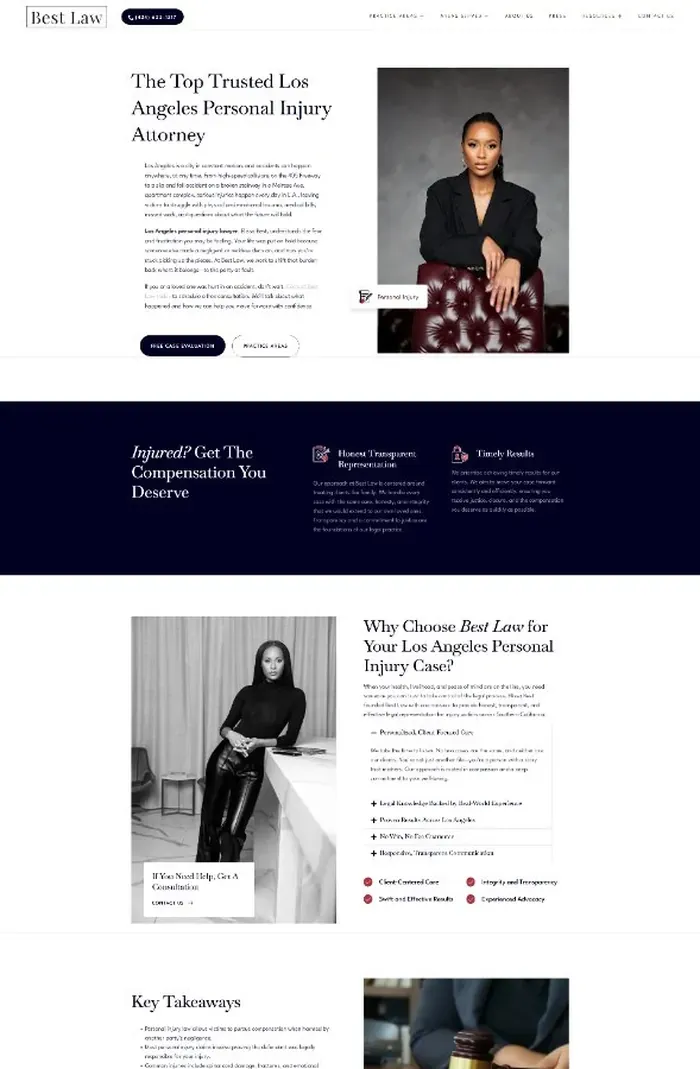
Portfolio spotlight
USA · Legal
Personal injury law firm website with 9+ practice areas, testimonials, and free case evaluation.
View live site: best-law.netHow we work
Every project follows the same four-phase process. You always know what week you are in, what is being delivered, and what we need from you. Fixed timeline, fixed price, in writing before we start.
DELIVERABLES
We audit your current site for technical SEO, Core Web Vitals, schema gaps, and MRPC compliance issues. Then we map your keyword targets by practice area and city: Baltimore, Annapolis, Frederick, Silver Spring, wherever your clients come from. You receive a written strategy document that becomes the blueprint for everything built in Phase 3.
DELIVERABLES
We design your homepage and key practice area pages in Figma across desktop and mobile, based on your firm's positioning and competitive landscape. Simultaneously, we draft all page copy following MRPC guidelines and your brand voice. You review both in one consolidated feedback round on a private staging URL.
DELIVERABLES
Approved designs go into WordPress on our performance stack. We build every practice area page, attorney bio page, and intake form with conditional logic, and implement LegalService + Attorney schema markup on every relevant page. Internal linking is structured from day one, not retrofitted. You get a staging link to review progress weekly.
DELIVERABLES
We handle DNS cutover, 301 redirect mapping from your old URLs, and sitemap submission to Google Search Console. Your Google Business Profile is audited and fully optimized in the same window. You receive a plain-English handoff document, a video walkthrough, and a 30-day post-launch monitoring window where we resolve anything that surfaces.
Most clients are live within 10 weeks of their first call. No retainer required after launch.
Transparent pricing
Every tier is fixed price, fixed scope, fixed timeline, defined in a written statement of work before we invoice a dollar. No hourly billing. No surprise line items for additional revisions. You know exactly what you are buying and when it will be done.
All tiers available with a monthly care plan from $150/month, covering WordPress updates, weekly backups, uptime monitoring, and priority support within 4 business hours.
How we compare
Maryland law firms have four common options for their website. The differences in schema control, compliance support, and code ownership determine which option actually compounds in value over time.
| Factor | Upcoming Brand WordPress | FindLaw / Martindale Legal SaaS | Squarespace / Wix Website builder | Generic agency Template shop |
|---|---|---|---|---|
| LegalService schema control | Full JSON-LD, all fields | Platform-controlled, limited | No custom JSON-LD support | Generic LocalBusiness only |
| MRPC compliance support | Built into every copy draft | Templates only, no review | None | Rarely understood |
| Code and domain ownership | Yours, forever | Platform owns domain/content | You own domain, not code | Yours |
| Monthly cost after launch | $150/month (care plan, optional) | $500 to $2,000/month locked-in | $23 to $65/month (platform fee) | Varies; $200+/month retainer |
| Core Web Vitals performance | Guaranteed green on delivery | Substandard (platform bloat) | Acceptable but not competitive | Depends on template choice |
| Multi-step intake form | Conditional logic, CRM integration | Basic form only | No conditional logic | Varies by agency |
| Local Pack ranking upside | High (schema + GBP + citations) | Moderate (directory authority) | Low (no schema, limited SEO) | Low to moderate |
FindLaw and Martindale offer directory listings with real traffic value. That is separate from building and owning your own law firm website. Many Maryland firms do both: a strong owned site plus directory listings.
Complete guide
Everything Maryland attorneys need to know about building a website that ranks, converts, and complies with bar rules, written by a studio that has built law firm sites exclusively in this market.
Most business websites are brochures. A law firm website is an intake infrastructure system. Whether you call it lawyer website design, attorney web design, or simply a legal site, the distinction matters more than most attorneys realize, and it is the main reason general-purpose web agencies routinely fail law firms despite producing visually polished sites.
A retail or service business website succeeds by showcasing products, communicating pricing, and building brand appeal. Visitors browse, compare, and buy on their own timeline. Legal consumers do not work that way. Someone searching for a Maryland criminal defense attorney at 11 PM after an arrest is not browsing. They are in crisis. The website's entire architecture must be engineered around that moment: fast load, immediate trust signal, visible phone number, frictionless intake path.
The technical requirements also diverge sharply from standard business sites. Google uses LegalService schema markup, not generic LocalBusiness schema, to evaluate and display law firm results in Google Local Pack and knowledge panels. Attorney sites need structured data that identifies practice areas, jurisdictions served, bar admissions, and geographic service areas in machine-readable JSON-LD schema format. Generic agencies rarely implement this correctly because they simply do not build attorney sites regularly enough to know the difference.
Maryland Rules of Professional Conduct impose hard constraints on attorney website content that do not exist for other industries. You cannot make outcome guarantees, claim superiority with superlatives, or use testimonials in ways that imply typical results. A general copywriter who does not know Rule 7.1 will write content that sounds great but exposes the firm to bar complaints. This is not theoretical. Maryland attorneys have faced disciplinary proceedings over website language.
Conversion architecture for legal audiences differs fundamentally from e-commerce or lead-gen sites. The call to action on a law firm site is not "add to cart." It is "begin a conversation with a professional who will evaluate whether I can help you." That requires a different kind of trust pathway. Visitors need to see attorney credentials, relevant case experience, geographic familiarity, and clear next steps before they will submit their name and phone number. A basic contact form with three fields (name, email, message) is not an intake form. It is a feedback form, and it converts accordingly.
A qualifying intake form, by contrast, collects case type, preferred contact time, urgency level, and basic facts while routing submissions to the right team member automatically. The difference in lead quality and conversion rate between these two approaches is substantial: a well-designed multi-step intake form consistently outperforms a generic contact form by three to four times on law firm sites. This is why strong attorney website design and law firm marketing strategy must be planned together from the start, not treated as separate projects.
Attorney websites also carry unique accessibility obligations. ADA Title III litigation involving law firm websites has increased consistently since 2018. A firm that counsels clients on civil rights while operating an inaccessible website faces both legal exposure and reputational risk. Proper color contrast ratios, keyboard navigation, ARIA labels, and screen-reader-compatible markup are not optional enhancements. They are baseline requirements for any professionally built law firm site in Maryland today.
The page architecture of a law firm website determines both its search performance and its ability to convert visitors into consultations. Firms that try to consolidate everything onto a few pages consistently underperform against competitors with properly structured site architectures, even when the consolidated site looks more polished.
The homepage serves one primary function: establish immediate trust and route visitors to the right practice area page within two clicks. It should include a clear value statement, the geographic market served, a visible phone number above the fold, practice area navigation, and a brief credibility section. The homepage is not the place to explain every service in depth. That is what practice area pages are for.
Dedicated practice area pages are the single most important structural decision in law firm SEO. Google ranks pages, not websites. A firm that handles criminal defense, personal injury, and family law cannot compete on all three terms with a single page that mentions all three. Each practice area needs its own page with its own title tag, H1, content depth, schema markup, and internal linking structure. Firms that consolidate practice areas onto a single page consistently rank for none of them at a competitive level.
Attorney bio pages are high-intent ranking assets that most firms underinvest in. When a prospective client finds a firm through a practice area search, the next step is almost always to research the attorney personally. Bio pages that are thin, generic, or missing entirely lose cases that the practice area page already won. Each bio should include bar admissions, law school, years of practice, areas of focus, community involvement, and a professional photograph that communicates approachability, not just authority.
Jurisdiction-specific city pages expand the firm's geographic reach without requiring multiple office locations. A Maryland firm serving Baltimore, Annapolis, Frederick, and Bethesda can create legitimate, substantive pages for each city, covering local courts, typical case timelines in that jurisdiction, and the firm's history working in that area. These pages rank for city-plus-practice-area searches and drive meaningful consultation volume from markets outside the firm's primary office location.
A well-designed 404 page with navigation links and a phone number recovers a percentage of visitors who would otherwise leave. FAQ and resource pages serve dual purposes: they answer common pre-consultation questions (reducing consultation time spent on basics) and they build E-E-A-T signals that Google evaluates when determining the authority of legal content. A firm with ten detailed FAQ answers about Maryland DUI law will consistently outrank a competitor with a bare-bones service description, all else being equal. ADA accessibility requirements apply to every page, not just the homepage, and should be built into the template from the start rather than retrofitted later.
Structured data markup is the layer of code that tells Google's systems exactly what your website is, what services you offer, where you operate, and who your attorneys are, in machine-readable format. Without it, Google has to infer this information from your content. With properly implemented schema, you give Google explicit confirmation that reduces ambiguity and improves the accuracy of how your site is classified and displayed.
JSON-LD is the format Google recommends for structured data. It lives in a script tag in the page's head section and does not affect the visual appearance of the page in any way. The code declares your page's meaning to search engines independently of what human visitors see. This is distinct from meta tags (title, description) and has nothing to do with keywords in your page content. It is a separate communication channel between your site and Google's indexing systems.
For law firm websites, the correct schema type is LegalService, which inherits from LocalBusiness. The critical fields for a Maryland law firm include: name, url, telephone, address (with addressRegion set to MD), areaServed (listing the Maryland counties or cities you serve), serviceType (the practice area), and priceRange if applicable. Many agencies implement generic LocalBusiness schema on attorney sites because they do not know LegalService exists as a distinct type. This matters because LegalService schema signals to Google that the business is a legal services provider, which is relevant for Local Pack category matching.
Attorney and Person schema on bio pages identifies individual lawyers by name, links them to their employer (the firm), and specifies their credentials and areas of expertise. This schema helps bio pages rank for attorney-name searches and contributes to the firm's overall E-E-A-T profile. Google's quality evaluator guidelines explicitly cite author credentials as a trust signal for legal and financial content. Person schema helps surface those credentials to the system.
Common schema mistakes Maryland law firms make include: using LocalBusiness instead of LegalService, omitting areaServed entirely (leaving Google to guess your geographic reach), using incorrect address formatting that doesn't match your Google Business Profile NAP, and implementing schema for the homepage only while leaving practice area and bio pages unstructured. Each of these errors reduces Google's confidence score for your site's local relevance. A site with consistently implemented LegalService schema across all practice area pages, combined with matching GBP data and citation consistency, sends a coherent local authority signal that generic sites without schema simply cannot match.
After implementing schema, use Google's Rich Results Test to validate each page's markup. Look for zero errors and zero warnings. Then check Search Console's Enhancement reports for any coverage issues Google surfaces after crawling. Schema implementation is not a one-time task. When you add new practice areas, new attorney bio pages, or new city pages, each one needs appropriate schema markup from the start.
Attorney websites are attorney advertising. The Maryland Rules of Professional Conduct govern what Maryland-licensed attorneys can and cannot say in their marketing, including every page of their website. Most national legal marketing agencies are not Maryland bar experts. They write copy that works in other states, apply it to Maryland firm websites, and leave the attorney exposed to bar complaints they never anticipated.
Rule 7.1 prohibits false or misleading communications about a lawyer or their services. This is the broadest and most consequential rule for website content. A communication is misleading if it omits information necessary to make the stated content not misleading, which means technically accurate statements can still violate Rule 7.1 if they create false impressions through omission. Case result descriptions, for example, must include enough context that a reader understands those results were specific to facts that may not apply to their situation.
Rule 7.2 governs advertising broadly and requires that all attorney advertising include the name and contact information of at least one responsible attorney. This applies to your website. Rule 7.4 restricts claims of specialization: Maryland attorneys cannot claim to be a "specialist" in a practice area unless they hold a certification from an organization approved by the Maryland Bar. This eliminates common marketing language like "Maryland's leading DUI specialist" or "specialist in personal injury law."
Rule 7.3 addresses solicitation and restricts real-time electronic contact with prospective clients under specific circumstances. The chatbot on your website, if it initiates conversations proactively with visitors rather than responding to client-initiated inquiries, may create solicitation issues depending on how it is configured. Passive chat widgets that wait for the visitor to initiate are generally acceptable; AI-driven pop-up solicitation sequences are more complicated.
Proper disclaimer placement is not just fine print. Required disclosures should appear near the claims they qualify, not buried in site footers where they functionally disappear. If your homepage features a case result, the disclaimer qualifying that result belongs near the result, not on a separate disclaimer page that nobody reads. The Maryland Attorney Grievance Commission has taken the position that disclaimers must be reasonably conspicuous. Small gray text at the bottom of a long page does not meet that standard.
Rule 7.5 governs firm names. Trade names are permitted in Maryland as long as they are not misleading, but names implying government affiliation, national scope without national practice, or the involvement of attorneys who are not actually affiliated with the firm create Rule 7.5 issues. Website copy must be reviewed for MRPC compliance before publication, not as an afterthought after the site goes live. Any studio working on Maryland law firm websites should understand these rules well enough to flag compliance issues during content development, not after launch.
Local SEO for law firms is not the same as general SEO, and Maryland's competitive legal market makes the distinction consequential. Attorney SEO, in particular, requires balancing technical performance, local signals, and bar-compliant content in ways that most generalist SEO agencies are not equipped to handle. When someone searches "DUI attorney Baltimore" or "divorce lawyer Annapolis," Google serves two distinct result types: the Local Pack (the map with three listings) and organic results (the blue links below). These are separate algorithms with separate ranking factors, and top performance requires optimizing for both simultaneously.
The Local Pack is primarily driven by proximity, relevance, and prominence. Google evaluates how close the firm is to the searcher, how relevant the firm's GBP category and content are to the search query, and how prominent the firm appears across the web (reviews, citations, links). A Maryland firm with a complete, active Google Business Profile, consistent citations across legal directories, and a strong review profile will outperform a firm with a better website but neglected GBP presence for Local Pack positions.
Google Business Profile optimization goes well beyond filling out your address and phone number. Category selection matters: "Law Firm" is a broad category. Adding specific secondary categories like "Criminal Justice Attorney," "Personal Injury Attorney," or "Family Law Attorney" signals practice-area relevance to the algorithm. GBP posts, Q&A responses, and photo freshness all contribute to the profile's activity signals. Service areas should be explicitly set for every Maryland county or city the firm serves.
Citation consistency means your firm's NAP (name, address, phone number) must be identical across every directory listing. The format matters: "Suite 200" versus "Ste. 200" versus "#200" are technically different strings. Discrepancies across Avvo, FindLaw, Justia, Yelp, and the firm's own website create conflicting signals that reduce Google's confidence in the firm's location data. A citation audit and cleanup is the fastest-impact local SEO action available to established firms.
Review acquisition strategy requires MRPC awareness. Maryland rules permit attorneys to ask clients for reviews after representation concludes, provided the request is not coercive or linked to compensation. A simple follow-up email or text message to a satisfied client asking them to share their experience on Google is compliant. Posting fake reviews, incentivizing reviews with discounts or referral credits, or asking for reviews before representation ends creates bar compliance exposure. A consistent stream of authentic reviews, even a few per month, compounds significantly over 12 to 18 months and becomes a durable Local Pack ranking asset that competitors cannot easily replicate.
Targeting multiple Maryland markets from a single office requires a city landing page strategy rather than location manipulation. Genuine city-specific pages that address local court procedures, typical case handling in that jurisdiction, and the firm's specific experience in that market are legitimate and effective. Pages that simply swap city names into identical content templates are thin content that Google's systems increasingly identify and discount. Each city page should include substantive, locally relevant information that a prospective client in that specific market would find useful. Firms that invest in ongoing legal SEO services and lawyer SEO services from a Maryland-based provider consistently outpace competitors that treat SEO as a one-time task.
Core Web Vitals are Google's standardized performance metrics that measure the actual user experience of loading and interacting with a webpage. They became official Google ranking signals in 2021 and have grown in weight since. For law firm websites, poor Core Web Vitals performance is not just a technical problem. It is a case acquisition problem. A site that takes four seconds to load on mobile has already lost the prospective client before they read a single word.
The three primary metrics are Largest Contentful Paint (LCP), Interaction to Next Paint (INP), and Cumulative Layout Shift (CLS). LCP measures how long it takes for the largest visible content element (the hero image or headline), to load. Google's target is under 2.5 seconds. INP measures how quickly the page responds to user interactions like taps and clicks; the target is under 200 milliseconds. CLS measures visual stability, meaning how much page elements shift as the page loads; the target is under 0.1.
Approximately 44% of attorney websites fail at least one Core Web Vital, according to consistent analysis of legal industry sites. The primary causes are predictable: oversized hero images that are not properly compressed or converted to modern formats like WebP, plugin bloat from legal-specific SaaS platforms that load dozens of third-party scripts, render-blocking JavaScript that delays page interactivity, and unoptimized web fonts that trigger layout shift as they load. Each of these issues has a specific technical solution; none of them require a complete site rebuild to fix.
Slow law firm sites lose cases before the phone rings. A prospective client who arrives at your site during a crisis, searching for help from a hospital waiting room or a police station parking lot on a slow mobile connection, will leave if the page does not load within two to three seconds. They will not wait. They will return to Google and call the firm whose site loaded. This is not hypothetical user behavior theory; it is documented by Google's own research showing that mobile bounce rates increase by 32% when page load time increases from one second to three seconds.
A proper WordPress performance stack for a Maryland law firm site includes: a lightweight theme (Astra or GeneratePress), WP Rocket for page caching and asset minification, Cloudflare CDN for global edge delivery, proper image optimization at the file level before upload, and hosting on a server stack with PHP 8.2 or higher and server-side caching enabled. Kinsta, WP Engine, and Cloudways all provide this infrastructure with managed WordPress environments. Shared hosting on GoDaddy or Bluehost is not an appropriate foundation for a law firm site competing in a Maryland market. The performance ceiling is too low to achieve consistent Core Web Vitals scores under Google's thresholds.
The intake form is the most consequential element on a law firm website, and it receives the least design attention of any component. Most law firm sites deploy a generic three-field contact form (name, email, message) and measure its performance by whether submissions arrive in an inbox. This is the wrong measurement. The right measurement is qualified consultations booked per month. Law firm lead generation lives or dies on intake form architecture, and that architecture determines conversion numbers more than any other single website element.
Single-page contact forms convert at two to three percent of form views on law firm sites. Multi-step intake forms consistently reach eight to twelve percent. The conversion difference comes from psychology, not magic. Multi-step forms work because they apply commitment and consistency principles: once a visitor completes the first step, they are more likely to complete subsequent steps. They also work because they feel less invasive. Asking for a name and case type on step one is lower-commitment than asking for name, phone, email, case description, and contact preference all at once on a single page.
Qualifying question structure matters as much as form length. The first question should identify case type (criminal defense, personal injury, family law, etc.) because this determines everything that follows. Step two should capture urgency (court date within 30 days, active investigation, just exploring options) because it allows the intake team to prioritize follow-up correctly. Step three captures contact information. This order, case type first, urgency second, contact last, reduces SPAM submissions because automated bots and low-intent visitors drop off after step one.
Conditional logic transforms a linear form into an intelligent intake pathway. A visitor who selects "DUI / Traffic" on step one sees different follow-up questions than a visitor who selects "Family Law / Divorce." The DUI visitor gets asked about license suspension urgency and court date; the divorce visitor gets asked about whether children are involved and whether the situation is contested. This specificity makes the firm appear responsive and knowledgeable before the first conversation even happens.
CRM integration determines whether intake form submissions become billable clients or lost leads. Clio Grow is the most attorney-specific option, connecting directly with the Clio practice management system to create matter records automatically from form submissions. Lawmatics provides more sophisticated marketing automation with drip sequences and lead scoring. HubSpot works well for larger firms with dedicated marketing staff who can manage the platform. The choice of CRM determines your follow-up speed, and research consistently shows that leads contacted within five minutes of form submission convert at dramatically higher rates than leads contacted after 24 hours.
Mobile form UX deserves specific attention because a significant percentage of legal searches happen on mobile devices, during urgent situations. Form fields should be large enough to tap accurately without zooming. Phone number fields should trigger the numeric keyboard on iOS and Android. Progress indicators reduce abandonment by showing visitors how close they are to completion. The thank-you page, the page visitors see after submitting, is not a dead end. It should confirm receipt, state when the firm will respond, offer a phone number for urgent matters, and optionally provide a resource relevant to their case type that keeps them engaged while they wait.
Platform choice is one of the most consequential decisions a Maryland law firm makes about its website, and it is made with the least information. The three primary alternatives to WordPress, namely Squarespace, Wix, and Webflow, are legitimate platforms for many business types. They are poor choices for law firm websites in competitive Maryland markets, for reasons that become apparent only after a firm tries to optimize beyond the basics.
WordPress dominates law firm web development for specific technical reasons. Schema markup on Squarespace and Wix is limited by what those platforms expose through their interfaces. Implementing custom JSON-LD schema LegalService markup with full field control is not possible on either platform. WordPress allows complete control over page-level structured data through plugins like RankMath Pro or through custom code in theme files. This schema control is not optional for firms competing seriously for Local Pack positions in Maryland markets.
The recommended WordPress stack for Maryland law firm website builds has been refined through consistent results across multiple sites. Astra Pro as the theme provides extremely fast base performance, extensive customization options, and clean HTML output that does not introduce technical SEO problems. Elementor Pro handles page building with a visual editor that allows precise layout control without compromising performance when used correctly. RankMath Pro manages all on-page SEO settings, schema markup, and sitemap generation from a single interface. WP Rocket handles page caching, file minification, lazy loading, and CDN integration. Cloudflare provides the CDN layer and handles DDoS protection, which matters for high-value legal sites that occasionally attract targeted traffic attacks.
Hosting selection determines the performance ceiling. Kinsta provides managed WordPress hosting on Google Cloud infrastructure with automatic scaling, daily backups, and staging environments. WP Engine offers similar managed infrastructure with strong customer support. Cloudways provides more flexibility for agencies managing multiple sites with cost efficiency. Any of these three options provide appropriate infrastructure for a law firm site. GoDaddy shared hosting, Bluehost, or Hostgator hosting plans are not appropriate foundations for sites competing in Maryland legal markets. The server response times alone prevent achieving target Core Web Vitals scores.
Legal-specific SaaS website builders, platforms that market themselves directly to law firms and bundle website hosting with directory listings and lead generation, deserve specific caution. These platforms lock your content, your URL structure, your Google Business Profile ownership, and your accumulated domain authority into their proprietary systems. When you leave the platform, you frequently cannot take your site's history with you. Firms that have spent years building rankings on a FindLaw or Martindale-managed site discover their domain is owned by the platform, their content cannot be migrated, and they must start from zero on a new domain. Ownership of your website's domain, hosting, and content is a foundational requirement, not a premium feature.
Attorney bio pages are the highest-intent pages on most law firm websites, and they receive less design and content attention than any other page type. The strategic error is understandable: firms prioritize practice area pages for SEO and the homepage for first impressions, treating bio pages as obligatory but secondary. The conversion data does not support this prioritization. Bio pages frequently show higher time-on-page, lower bounce rates, and stronger conversion-to-consultation ratios than any other page type on attorney sites.
The reason is simple: a prospective client who lands on a bio page has already decided they may want to hire this firm. They are researching the specific person they will entrust with their legal matter. This is the highest-intent moment in the entire decision journey, and a thin, generic bio page squanders it. A bio that says "Attorney Jane Smith has 15 years of experience and is dedicated to her clients" answers no questions and builds no trust. A bio that explains Jane Smith's specific experience handling Baltimore County DUI cases, her record in District Court, her approach to client communication, and why she chose criminal defense law answers the actual questions a prospective client is asking.
Bio pages rank independently for attorney-name searches. When a referral source mentions an attorney by name, the prospective client immediately searches for that name. A bio page optimized for the attorney's name, bar admission jurisdiction, and practice areas captures this traffic. Without a well-structured bio page, this search intent is captured by Avvo, LinkedIn, or Martindale profiles, off-site pages that the firm does not control and that may not present the attorney's information in the most favorable light.
Person schema on bio pages contributes to the firm's E-E-A-T (Experience, Expertise, Authoritativeness, Trustworthiness) profile. Google's quality evaluator guidelines specifically flag legal content as YMYL (Your Money or Your Life), content where accuracy matters significantly and where author credentials are a trust signal. Person schema that identifies the attorney's name, their role at the firm, their alma mater, their bar admissions, and links their bio to the firm's LegalService schema creates a structured trust signal that Google can evaluate programmatically.
Photography direction for attorney bios matters more than most firms acknowledge. A prospective client choosing a lawyer is making a significant trust decision. Photos that look like driver's license photos, with flat lighting, a distant expression, and a formal suit against a gray background, communicate competence but not approachability. Photos that communicate both, using warm but professional lighting, direct eye contact, and a natural expression in an authentic setting, consistently outperform generic headshots on conversion metrics. The photo does not need to be expensive. It needs to communicate that a real, capable human being is behind the firm name. Bio copy must navigate MRPC compliance carefully: specific descriptions of case experience are compliant when factual; outcome promises and superlative characterizations are not. A well-written bio describes what the attorney has done, not what they guarantee to do.
Law firm website pricing in Maryland in 2026 spans a wide range, and understanding what drives that range is essential for making an informed investment decision. The cheapest option is not the most cost-effective option. A $1,200 website that fails to rank, converts at 1%, and requires a rebuild in two years costs more in lost case revenue than a $6,000 site that performs correctly from launch. The relevant question is not "what does it cost to build?" but "what is the cost per consultation generated over 24 months?"
Entry-level professional law firm website builds in the Maryland market start around $1,500 to $2,500. At this price point, you should expect a professionally designed WordPress site with a homepage, two to three practice area pages, a contact page, mobile responsiveness, and basic on-page SEO setup. Schema markup, multi-step intake forms, city landing pages, and custom content are not included at this tier. This is appropriate for a solo practitioner in a low-competition niche who primarily relies on referrals and needs a credibility site rather than an acquisition engine.
Growth-tier builds for Maryland law firms range from $3,500 to $6,000. This price range covers: a full homepage with conversion architecture, five to ten dedicated practice area pages with custom content, attorney bio pages with Person schema, a multi-step intake form with CRM integration, core local SEO setup including schema markup and GBP optimization guidance, Core Web Vitals optimization, and mobile-first design. This is the appropriate investment tier for firms competing in Baltimore, Bethesda, Annapolis, or other competitive Maryland markets where organic search is a meaningful case acquisition channel.
Full custom builds for multi-attorney firms, multi-practice firms, or firms competing in multiple Maryland markets range from $6,000 to $10,000 or more. Cost drivers at this tier include: large attorney rosters requiring individual bio pages with custom photography direction, complex intake logic with multiple practice-area-specific pathways, multi-location schema implementation, city landing page packages for five or more markets, custom design that differentiates visually from template-based competitors, and integration with practice management systems like Clio.
Hidden costs that surprised attorneys when not budgeted upfront include professional copywriting (expect $150 to $300 per page for attorney-specific content written by someone who understands MRPC), professional photography ($400 to $800 for a half-day shoot covering headshots and office environment), stock photography licensing ($50 to $200 per image from premium legal stock libraries), ongoing hosting ($50 to $150 per month on managed WordPress hosting), and SSL certificate management. DIY website builders appear free or nearly free until you account for the true cost: staff hours managing the platform, foregone ranking performance from technical limitations, and conversion losses from inadequate intake architecture. A Maryland attorney billing $300 per hour who spends 40 hours annually managing a DIY site has spent $12,000 in opportunity cost to save $3,000 in build fees.
Law firm website migrations are among the highest-risk web projects in any industry. The reason is clear: law firm sites accumulate ranking authority slowly over years, and a poorly executed migration can destroy that authority in days. A firm that has ranked on page one for "personal injury attorney Baltimore" for three years can lose that position within weeks of a careless platform migration. Recovery from a bad migration takes four to eight months and requires significant SEO remediation work on top of the migration costs already spent.
The most common migration triggers for Maryland law firms are platform dissatisfaction (moving off FindLaw, Wix, or Squarespace to WordPress), rebranding (new firm name, new domain), outdated technology (sites built pre-2018 on themes and plugins that are no longer maintained), or acquisition of a competing firm whose site needs to be merged. Each of these scenarios carries different technical risks, but the fundamental migration principles apply across all of them.
What goes wrong in poorly managed migrations: URL structure changes without 301 redirects are the single most catastrophic error. If your current site has a page at /practice-areas/dui-defense and the new site places it at /criminal-defense/dui, every link pointing to the old URL now hits a 404 error. Google loses its accumulated trust in that page's authority, external links become dead, and any ranking position that page held is effectively reset. A comprehensive redirect map, matching every old URL to its new equivalent, must be implemented before the new site goes live, not after problems are discovered in Search Console.
The migration checklist for a Maryland law firm site should include: crawling the current site with Screaming Frog to document every indexed URL and its metadata, mapping each existing URL to its new equivalent or to the closest relevant page, implementing all 301 redirects in the web server configuration (not WordPress redirect plugins, which load after WordPress boots and create unnecessary overhead), testing every redirect before launch, submitting an updated XML sitemap to Google Search Console immediately post-launch, and monitoring Search Console's Coverage and Performance reports for two to three months post-migration to catch any issues Google surfaces through crawling.
Clean migrations from well-structured sites show ranking recovery within four to six weeks as Google recrawls and reprocesses the redirected URLs. Migrations involving domain changes (moving from the firm's old domain to a new one) take longer because domain authority does not transfer completely through 301 redirects. Approximately 80 to 90% of link equity passes, with the remainder lost in the transition. Migrations from locked platforms like FindLaw or Martindale-managed sites carry additional complexity because the existing domain is owned by the platform. In these cases, the firm is effectively starting fresh on a new domain, which requires a longer timeline (six to twelve months) to recover comparable ranking positions through new domain authority building. Knowing this reality before committing to a migration helps set accurate expectations about the post-launch SEO trajectory.
A law firm website is not a one-time project. It is a piece of operating infrastructure that requires ongoing maintenance, security management, and SEO development to retain its value. The most common mistake Maryland law firms make after a successful website launch is treating the site as complete, as a finished deliverable rather than a living system. Sites that receive no attention after launch degrade in performance, security posture, and ranking position over 12 to 24 months, without any visible sign on the frontend until a problem becomes acute.
WordPress maintenance requirements are non-optional. WordPress core updates ship regularly, addressing security vulnerabilities and compatibility improvements. Plugin updates follow their own release schedules, and compatibility conflicts between plugin versions are a common cause of site functionality failures. PHP version upgrades, moving from PHP 8.1 to 8.2 to 8.3 as the hosting environment advances, require testing to ensure plugin compatibility. A site running outdated PHP and outdated plugins is progressively more vulnerable to security exploits. Law firm websites are targeted by hackers specifically because they are trusted by clients, making them valuable for phishing campaigns. A compromised law firm website creates MRPC ethical issues alongside the technical and reputational damage.
A proper care plan covers: monthly or bi-monthly core and plugin updates with compatibility testing on a staging environment before deployment to production, daily automated backups with offsite storage, security scanning and malware monitoring, uptime monitoring with alert notifications, SSL certificate management, and a defined response protocol for downtime incidents. Care plans range from $75 to $200 per month depending on the scope of coverage and the hosting environment. The cost of ignoring maintenance, whether a hacked site, a plugin conflict that breaks the intake form, or an SSL expiration that triggers browser security warnings, consistently exceeds annual care plan costs in a single incident.
SEO growth after launch follows a predictable development path for Maryland law firms that execute consistently. The first three months focus on indexation: ensuring all pages are crawled and indexed correctly, that schema markup is verified, and that Google Business Profile is fully optimized with the new site's information. Months three through six show initial ranking movement as Google processes the new content depth and authority signals. Months six through twelve show more stable ranking positions and are the appropriate time to begin expanding the site's content footprint. This is also when attorney marketing efforts, such as targeted content campaigns and citation building, compound most effectively with the site's established authority.
Quarterly SEO reviews should include: Search Console performance report reviewing impression trends and click-through rates, GA4 conversion tracking review to confirm intake form submissions are being tracked accurately, competitor analysis to identify new pages or content types competitors have added, and a content gap analysis to identify practice area or geographic terms the site does not yet rank for. The content development roadmap that emerges from quarterly reviews, for example adding a Maryland expungement page in Q2, a Frederick County family law page in Q3, and expanding the DUI FAQ section in Q4, compounds in value over time. A Maryland law firm that builds 12 well-optimized pages per year for three years has a content asset library that generates case inquiries autonomously, without ongoing advertising spend, and that becomes progressively harder for competitors to replicate from a standing start.
Every build includes
No add-on fees for the fundamentals. Every law firm website design project ships with the complete stack at one fixed price.
Transparent pricing
A custom WordPress website for a Maryland law firm costs between $1,500 and $10,000 depending on attorney count and market competitiveness. Solo practitioner sites start at $1,500. Every quote is fixed-scope - one price, no hourly surprises.
Need to spread the cost? Use our payment plan calculator. Full pricing breakdown →
For local searches in smaller Maryland markets like Frederick or Annapolis, firms see meaningful movement in 60 to 90 days post-launch. Competitive markets like Baltimore or Bethesda generally take 3 to 6 months for consistent first-page presence. Schema implementation and GBP optimization produce the fastest early gains. Local Pack improvements appear within 30 to 45 days. We set these expectations in writing during Discovery so there is no ambiguity.
Not if the migration is handled correctly. We map every existing URL to its new equivalent and implement 301 redirects before the DNS cutover. We submit updated sitemaps to Google Search Console immediately post-launch and monitor crawl errors during the 30-day post-launch window. Ranking dips during a clean migration are temporary and recover within 4 to 6 weeks. Migrations that lose rankings permanently are almost always missing redirect maps. We have never shipped a build without one.
We write all copy as part of every project tier. You provide the raw material, including your practice areas, notable case results you can ethically reference, and attorney bios, via a structured questionnaire. We draft copy that is MRPC-compliant, keyword-targeted, and written in a voice that sounds like your firm rather than a legal directory listing. You review one draft and provide factual corrections. We handle the rest.
Three things: schema requirements, compliance constraints, and conversion architecture. Law firm pages require LegalService and Attorney structured data that general business sites don't need. Attorney advertising in Maryland is governed by MRPC Rules 7.1 through 7.5, rules most generalist agencies are unaware of. And the conversion goal is a qualified intake submission, not a generic form fill, which requires a different form structure and page hierarchy than a retail or service business site.
Our WordPress care plan starts at $150/month and covers WordPress core and plugin updates, weekly backups, uptime monitoring, and priority support with a 4-business-hour response window. We also offer a content add-on that includes one new practice area page or city landing page per month, which compounds your SEO footprint over time. Care plans are month-to-month, no annual contract required.
No, and any agency that makes that guarantee is lying to you. What we do guarantee is that your site launches with green Core Web Vitals scores, fully implemented LegalService schema, a properly optimized Google Business Profile, and a sound on-page SEO foundation: the controllable inputs that give you the best chance to rank. We also provide a 90-day keyword tracking report so you can see exactly where movement is happening.
Law firm websites · Maryland
★★★★★ 5.0 on Google · 99% Job Success on Upwork
30 minutes · We review your site, your market, and tell you exactly what we'd build and what it costs.