Most restaurant websites lose diners before they make a reservation: outdated menus, no online booking, and sites that load in 8 seconds on mobile. We build WordPress sites for Maryland restaurants that rank locally, integrate with OpenTable or Resy, and turn visitors into regulars. Fixed-scope from $1,500.
Free site audit
We review your current site and send a plain-English audit within 2 business days. No sales call required.
Restaurant website design is building a custom WordPress website for restaurants, bars, and food service businesses that ranks in Local Pack for dining queries, presents an indexable HTML menu, and drives reservations and online orders without paying third-party commissions. The build centres on Restaurant and FoodEstablishment schema, a reservation integration, and an owned online ordering flow.
Why diners leave before booking
89% of diners research restaurants online before visiting (as of 2025), and 53% leave a site that takes more than 3 seconds to load. Most restaurant websites we audit load in 7–10 seconds on mobile. A diner searching 'seafood restaurant Annapolis' will book the first restaurant whose site loads and shows a menu, and that's rarely a site on shared hosting.
Without Restaurant and FoodEstablishment JSON-LD schema, Google cannot display your menu items, price range, cuisine type, or hours in rich results or the Local Pack. Generalist web agencies building restaurant sites without this markup leave you competing with full schema-enabled competitors on uneven ground.
A PDF menu is a dead end on mobile. Online reservation systems (OpenTable, Resy, or Tock) are now table stakes for Maryland restaurants competing for weekend bookings. If your site can't show an interactive menu and let diners book in under 60 seconds, you're losing covers to restaurants that can.
What we build into every site
A restaurant site is not a digital business card. It is your busiest front-of-house employee. Every element we build, from schema to menus to reservation flows, is designed to do one job: turn a searching diner into a booked table.
Every page receives Restaurant and FoodEstablishment JSON-LD markup: cuisine type, price range, menu URL, accepted payment types, operating hours, and reservation links. This is what enables rich results with your star rating, hours, and price range appearing directly in Google search. That's the difference between being clicked and being scrolled past.
We integrate your preferred reservation platform directly into your site: OpenTable, Resy, Tock, or a custom form. Diners can book a table without calling or leaving your site. We configure the widget to match your brand, embed it on the homepage and contact page, and ensure it works correctly on mobile, where most restaurant reservations are made.
We build interactive menu pages with your full menu organized by category (appetizers, mains, drinks, desserts) with prices, descriptions, and dietary flags (GF, V, vegan). Each menu item can receive MenuItem schema for potential rich results. Menu pages also rank for food-specific searches like 'oysters Annapolis' or 'crab cake Baltimore.'
Restaurant websites live and die by food photography. We build image-first layouts that showcase your best dishes with proper lazy loading, WebP compression, and retina display support, without slowing your site down. We also provide photo direction guidelines so your team knows exactly what shots will convert best on each page.
Appearing in the Google Maps 3-pack for 'restaurant near me' or 'seafood Annapolis' drives more covers than most paid advertising. We audit and optimize your GBP: correct cuisine categories, menu link, reservation link, hours, Q&A, and photo uploads. We also ensure consistency across Yelp, TripAdvisor, and OpenTable profile listings.
We guarantee your site ships with green Core Web Vitals scores. If it doesn't pass, we fix it before launch at no cost. Restaurant sites crammed with unoptimized food photos and embedded social feeds routinely fail these benchmarks. Our builds use CDN-delivered, WebP-converted images and a performance stack that keeps mobile load times under 2 seconds.
Portfolio spotlight
USA · Hospitality
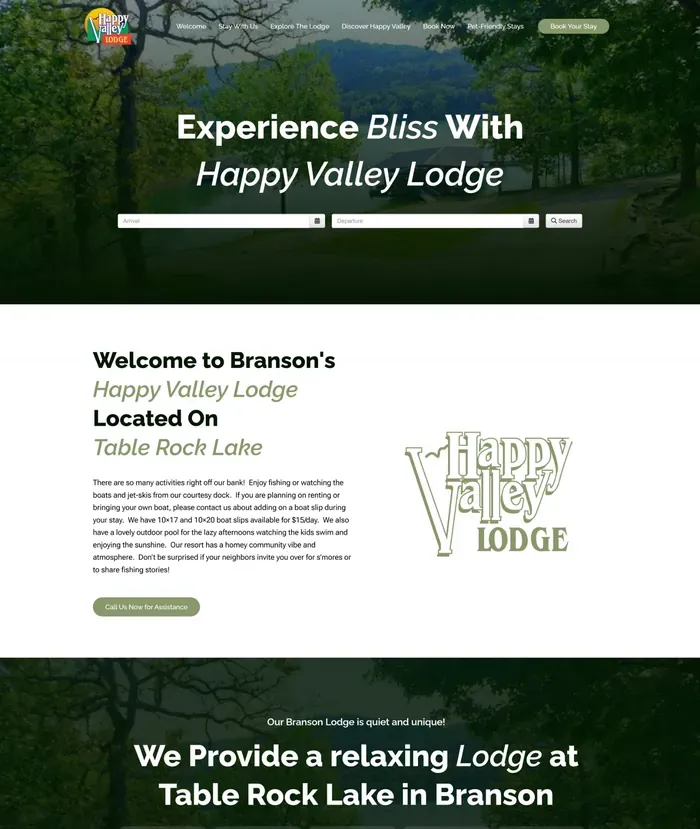
Lakeside resort website with date search booking and pet-friendly amenities showcase.
View live site: happyvalleylodge.comHow we work
Every project follows the same four-phase process. You always know what week you are in, what is being delivered, and what we need from you. Fixed timeline, fixed price, in writing before we start.
DELIVERABLES
We audit your current site for Core Web Vitals, schema gaps, and reservation friction. We research your top 5 local competitors' online presence and identify the gaps we can exploit. You receive a written strategy document covering keyword targets, GBP gaps, and exactly what pages we'll build.
DELIVERABLES
We generate your homepage, menu pages, and reservation experience using AI-assisted design for desktop and mobile, built around your cuisine and brand. We structure your menu content and draft page copy simultaneously. One consolidated feedback round keeps the project moving.
DELIVERABLES
Approved designs go into WordPress. Every page gets Restaurant and FoodEstablishment schema. Your reservation platform is integrated and tested across mobile and desktop. Interactive menus are built with proper markup. You get a staging link to review weekly.
DELIVERABLES
We handle DNS cutover, 301 redirects, and sitemap submission. Your GBP, Yelp, TripAdvisor, and OpenTable profiles are audited simultaneously. You receive a handoff video and 30-day post-launch monitoring window.
Most restaurants are live within 8 weeks of their first call. No retainer required after launch.
Transparent pricing
Every tier is fixed price, fixed scope, fixed timeline, defined in a written statement of work before we invoice a dollar. No hourly billing. No surprise line items. You know exactly what you are buying and when it will be done.
All tiers available with a monthly care plan from $150/month: WordPress updates, weekly backups, uptime monitoring, and priority support within 4 business hours.
Complete guide
Everything Maryland restaurants, bars, cafes, and hospitality businesses need to know about building a website that drives reservations, ranks in local dining searches, and gives guests the information they need before they arrive.
Most websites exist to convert a visitor over multiple sessions. A visitor reads a blog post, returns a week later to look at pricing, subscribes to an email list, and eventually becomes a customer. Restaurant websites don't work that way. The visitor making a reservation decision is doing so within minutes, on a mobile device, while physically hungry, and almost always within twenty-four hours of the intended visit. That time pressure changes everything about how a restaurant site should be designed and what it must prioritize.
Every person who lands on a restaurant website is trying to answer one of three questions as quickly as possible: what do you serve, how much does it cost, and how do I get a table? If your homepage doesn't answer all three above the fold on a mobile screen, you're losing reservations before a visitor scrolls. The design priority for a restaurant site is information delivery, not storytelling. Storytelling has a place, but it comes after the essential data has been surfaced.
Menu PDFs are one of the most common and most damaging mistakes in restaurant web design. A PDF menu fails guests on mobile because it forces pinch-and-zoom navigation on a small screen, requires a separate application to open, and frequently renders in a way that was never intended for portrait orientation. It also fails the restaurant in search because Google can't index the text inside a PDF the same way it indexes an HTML page. Every dish name, every ingredient, every cuisine term inside that PDF is invisible to search engines. An HTML menu page structured with proper headings and schema markup turns your menu into a search-ranking asset.
Food photography is not decoration. Multiple studies on restaurant conversion behavior show that pages with professional food photography produce significantly higher reservation and ordering intent than pages with no photography or amateur smartphone photos. The human brain processes images of food faster than text, and a compelling hero photo of your signature dish does more persuasive work in one second than three paragraphs of description. For restaurant websites specifically, the photography budget should be treated as a core production cost alongside the design and development budget.
From a technical search perspective, restaurants require Restaurant schema markup, which is a subtype of FoodEstablishment in the schema.org vocabulary. Generic LocalBusiness schema leaves significant structured data opportunity on the table. A proper restaurant website design Maryland strategy starts here. Restaurant schema allows you to specify cuisine type, price range, accepted reservations, menu URL, and opening hours in a format that Google reads directly and surfaces in search results. When a diner searches for Italian restaurants in Annapolis and your competitor has Restaurant schema but you have generic LocalBusiness markup, that competitor gets a richer search result presentation.
Google evaluates restaurant sites through the lens of local search, which means proximity, relevance, and prominence all factor into your ranking position. Yelp and OpenTable give you listings on those platforms, but they don't give you an owned digital asset. A Yelp page ranks for your restaurant name. Your own website, built correctly, can rank for cuisine terms, neighborhood terms, occasion searches, and long-tail queries that Yelp can't capture for your specific business. The restaurant that owns its web presence owns its reservation pipeline in a way that a Yelp-dependent business never will.
A restaurant website isn't a single page or a three-page brochure. Every page of a well-structured restaurant site serves a dual purpose: it answers a guest question and it creates a search-ranking opportunity for a distinct set of queries. Understanding both purposes helps explain why each page deserves real investment rather than a placeholder treatment.
The homepage is your highest-traffic page and your most important conversion surface. Above the fold on mobile, a guest should immediately see the cuisine type, an indication of price range, a reservation call-to-action, your hours today, and your location. Anything that requires scrolling to discover is a risk. Visitors who can't immediately confirm that you're open, that you serve food they want, and that they can book a table will leave for a competitor who makes that information obvious.
The menu page is arguably the most SEO-valuable page on the site. An HTML menu page with proper heading structure, dish names as text, cuisine-specific terminology, and ItemList or Menu schema markup will rank for food-type queries that a PDF menu cannot touch. It also gives guests the ability to browse on mobile without fighting a zoom interface. Menu pages should be organized by meal period and category, with stable URLs that do not change when seasonal items rotate.
A reservations page reduces friction in the booking process and should be linked prominently from the homepage, the menu page, and the site header. Whether you embed a third-party reservation widget or use a native form, the page should communicate wait times, parking information, and any reservation policies such as deposit requirements or party size limits.
An events and private dining page captures high-value bookings that individual diners do not represent. A party of twelve for a corporate dinner or a buyout for a wedding rehearsal dinner is worth five to ten times a standard reservation in revenue per event. These searchers use specific queries like "private dining room Baltimore" or "restaurant event space Annapolis" and an optimized page for these terms converts that search traffic into real inquiry volume.
The about and story page builds trust and supports the brand narrative that distinguishes your restaurant from a chain. Guests who care about locally owned businesses, farm-to-table sourcing, or the chef's background will check this page before committing. It also provides natural opportunities for keyword-rich content about your culinary philosophy and connection to the Maryland food community.
Each of these pages contributes to the overall authority of the site in Google's local search algorithm. A site with eight well-structured pages about a single restaurant sends stronger relevance signals than a two-page site with no internal linking depth.
Schema markup is structured data added to your website's HTML that tells search engines precisely what your page contains. For restaurants, this structured data directly affects how your business appears in Google search results, including whether Google displays your cuisine type, price range, hours, and star ratings directly on the search results page before a visitor ever clicks your link.
Restaurant is a named type in the schema.org vocabulary and is a subtype of FoodEstablishment, which itself is a subtype of LocalBusiness. Using the specific Restaurant type rather than the generic LocalBusiness type signals more precisely what your business is, which allows Google to apply restaurant-specific result formatting when your listing qualifies for rich results.
The core fields every Maryland restaurant site should implement in its Restaurant schema include: name, address (using PostalAddress type), telephone, url, servesCuisine (which accepts a text value like "Italian" or "Seafood" and can accept multiple values), priceRange (using the dollar sign convention from $ to $$$$), hasMenu (linking to your HTML menu page URL), acceptsReservations (boolean true/false), and openingHoursSpecification (a structured list of each day's open and close times using DayOfWeek values).
Menu schema, implemented separately from the Restaurant schema, allows you to mark up your actual dishes with the MenuItem type. Each MenuItem can include the name of the dish, a description, the menu section it belongs to, and a price offer. When Google parses this data, it can surface specific dishes in search results, which is particularly valuable for restaurants with signature items or cuisine-specific dishes that diners search for by name.
Review schema and AggregateRating markup allow star ratings to appear in search results when your site hosts reviews or displays a review aggregate. This requires either displaying reviews on your own site or pulling structured data from a review aggregator in a way that meets Google's guidelines. Star ratings in search results consistently increase click-through rates compared to listings without them.
Maryland restaurants that implement complete Restaurant schema with Menu markup frequently appear in Google's restaurant-specific search result formats, including the local Knowledge Panel and the restaurant card format that displays cuisine, price range, and hours without requiring a click. This pre-click information reduces friction for diners who are ready to decide immediately and increases the quality of traffic your site receives.
The shift from PDF menus to HTML menus is one of the highest-impact decisions a restaurant can make for both search performance and guest experience. Yet the majority of Maryland restaurant websites still link to a PDF menu that was designed for print, displayed at a resolution intended for desktop viewing, and made available in a format that Google treats as secondary to native HTML content. Understanding why this matters and how to fix it is essential to building a restaurant website that actually works.
PDF menus fail on mobile because they were not designed for mobile. A typical restaurant menu is formatted for an 8.5 by 11 inch or larger sheet, landscape or portrait, with small type and dense layouts. On a phone screen, this requires the guest to pinch, zoom, scroll, and pan continuously to read dish names and prices. Most guests give up within seconds. A restaurant that forces this experience on a mobile visitor is actively driving that visitor to a competitor with a readable menu.
From a search perspective, Google indexes HTML content more thoroughly and reliably than PDF content. The text inside your PDF (every dish name, every description, every cuisine term) is effectively invisible to the organic search process that could be driving traffic to your site. An HTML menu page with dish names as actual text, organized under proper H2 and H3 headings that follow a logical menu structure, becomes a search-rankable asset. A page titled "Dinner Menu" containing dishes like "Maryland Crab Cake" and "Eastern Shore Rockfish" with schema markup will rank for queries that your PDF cannot.
Menu and MenuItem schema markup, applied to your HTML menu page, structures the data in a format that Google can parse and potentially surface in search results. Each menu section becomes a MenuSection object. Each dish becomes a MenuItem object with a name, description, and Offer with a price. This level of markup creates the foundation for dish-specific rich results and reinforces the cuisine and price range signals in your Restaurant schema.
We also build QR code menu pages, a single URL optimized for mobile scanning at the table, so guests can pull up your full HTML menu instantly without hunting for a physical copy.
The operational objection to HTML menus is that they are harder to update than a PDF. A PDF can be replaced with a new file upload. An HTML menu requires editing the page. This is a legitimate concern that your web design agency should address during the build by creating an easy editing workflow in your content management system. The long-term SEO and conversion benefit of an HTML menu far outweighs the marginal operational friction of learning to update it.
The reservation system is the most operationally critical integration on a restaurant website. Your restaurant reservation website needs to make booking frictionless, because every friction point between "I want to go" and "I have a reservation" is an opportunity to lose that booking to a competitor or to a diner who simply decides it's too much trouble. The choice of reservation platform and the way it is integrated into your WordPress site both matter significantly.
The major reservation platforms used by Maryland restaurants include OpenTable, Resy, Tock, SevenRooms, and Yelp Reservations. OpenTable has the largest consumer-facing marketplace, which means restaurants listed there benefit from discovery by diners who browse the OpenTable app directly. Resy has grown its market share significantly and is popular with independent and chef-driven restaurants. Tock is favored by restaurants using prepaid reservation models or timed tastings. SevenRooms is a more comprehensive hospitality CRM that combines reservations with guest profile management. Yelp Reservations integrates with the Yelp listing that your restaurant almost certainly already has.
The integration method matters as much as the platform choice. Most reservation platforms offer an embeddable widget that loads via an iframe or JavaScript snippet. If implemented naively, these widgets can add significant JavaScript weight to your page, increase load times, and negatively impact Core Web Vitals scores. The correct implementation approach is facade loading: the widget is not loaded until the user clicks a "Reserve a Table" button, at which point the widget JavaScript loads on demand. This keeps initial page load fast while still providing the full reservation functionality for visitors who request it.
What information you collect at the time of reservation affects both the guest experience and your ability to reduce no-shows. At minimum, the reservation flow should capture party size, date and time, and contact information for confirmation. Optionally, you can collect special occasion notes (birthdays, anniversaries), dietary restrictions, seating preference (inside, outside, bar), and for larger parties, a deposit or credit card hold.
For restaurants managing multiple revenue streams (dining room, private events, catering), consider whether a single reservation system can handle all booking types or whether separate systems are needed for different inquiry types. A dining reservation and a private event inquiry have fundamentally different information requirements and shouldn't be forced into the same form.
Local search is the primary search channel for restaurant discovery, and the way diners search for restaurants is specific enough that a local SEO strategy built for a law firm or a retail store won't transfer directly to the hospitality context. Local restaurant SEO requires a distinct approach, one built around cuisine terms, neighborhood modifiers, and Google Business Profile signals rather than the content-heavy tactics that work in other industries. Understanding how restaurant search queries are structured, how Google ranks local results, and what optimization actions have the highest impact is essential for any Maryland restaurant trying to grow through organic search.
Restaurant search queries follow predictable patterns. Cuisine-plus-location queries like "Italian restaurant Baltimore" or "seafood restaurant Annapolis" represent high-intent diners with a specific cuisine preference and a specific location in mind. Near-me queries like "restaurant near me" or "best brunch near me" are dominated by Google Business Profile proximity signals. Occasion queries like "romantic restaurant Baltimore" or "best birthday dinner Maryland" represent diners searching by experience type rather than cuisine, and these queries have less competition than cuisine-specific terms.
Google Business Profile (GBP) is the most important local SEO asset for a restaurant. Your GBP listing appears in Google Maps results and in the local pack (the three-listing block that appears in local search results). Optimizing your GBP listing means: selecting the most specific primary category (Restaurant, Italian Restaurant, Seafood Restaurant, etc.), adding all relevant secondary categories, uploading weekly photos of food and interior, keeping hours updated including holiday hours, adding attributes like "serves alcohol," "outdoor seating," "good for groups," and "accepts reservations," linking directly to your HTML menu page, and responding to every review professionally.
Citation consistency across directories is a foundational local SEO requirement. Your restaurant's name, address, and phone number must be identical across Yelp, TripAdvisor, OpenTable, Zomato, the Maryland restaurant association directory, and any local Baltimore or Annapolis food blog listings where your restaurant appears. Even minor inconsistencies like "St." vs "Street" in the address can suppress your local search rankings.
Review volume and quality are local ranking signals. A restaurant with 400 Google reviews averaging 4.3 stars will consistently outrank a restaurant with 40 reviews averaging 4.7 stars in proximity-equal searches. Developing a systematic process for encouraging guests to leave Google reviews, whether through follow-up SMS, receipt prompts, or server requests, is an ongoing local SEO activity that compounds over time.
Professional food photography is the single highest-return investment a restaurant can make in its website beyond the design and development work itself. Restaurants that treat their site as a food photography website, building image-first layouts around their best dishes, consistently outperform competitors relying on stock photos or unedited smartphone shots. The gap between professional food photography and amateur smartphone photography isn't a matter of aesthetic preference. It is a measurable conversion difference. Visitors to restaurant websites who see professional photography of dishes, interior, and atmosphere convert to reservations at a meaningfully higher rate than visitors who see dim, blurry, or compositionally poor images. For a business where the product is an experiential and visual one, this gap should not be surprising.
A full food photography session for a restaurant website should capture several categories of images. Hero shots are wide, styled images of your most visually compelling dishes, intended for use as full-width homepage or page header images. Detail shots are close-up images of individual dishes that will appear on your HTML menu page beside dish descriptions. Atmosphere shots capture the dining room, bar area, outdoor seating, and the overall vibe of the space at both day and night service. Team shots of the chef and front-of-house staff support the about page and humanize the brand. Signature cocktail and beverage photography is frequently overlooked but drives significant interest from the segment of diners who plan their restaurant visit around the bar program.
Briefing a food photographer for a restaurant session requires communicating the brand position, the priority dishes, the time of day for the shoot (ideally matching your natural service lighting), and the specific pages on your website where each image will be used. A photographer who understands that the hero image will be used at 1400px wide and cropped to 16:9 will compose the shot differently than one producing images for editorial use. Always brief around intended use, not abstract concepts.
Image optimization is where many restaurant websites undermine their photography investment. A 6MB JPEG from a professional camera, uploaded directly to WordPress without compression or resizing, will load in four to six seconds on a mobile connection and will damage your Core Web Vitals scores. All food photography should be converted to WebP format, resized to the maximum display dimension (1400px wide for heroes, 800px wide for inline menu images), and compressed to under 150KB per image. Modern WordPress image optimization plugins automate most of this process.
Restaurants that invest in quarterly photography updates, capturing seasonal menu changes, special events, and evolving interior design, compound the visual freshness of their website and their Google Business Profile over time. Stale photography from the opening year communicates neglect. Updated photography communicates an active, thriving business that cares about how it presents itself to potential guests.
Events and private dining represent a revenue category that many restaurant websites handle poorly by treating as a secondary consideration. A private dining buyout of a restaurant with fifty seats for a corporate event can generate more revenue in a single evening than three nights of regular service at average occupancy. Wedding rehearsal dinners, birthday celebrations, corporate holiday parties, and milestone anniversaries are all high-value events that require booking weeks or months in advance, from guests who are actively searching for exactly what you offer. A dedicated, optimized page for these services captures that search intent rather than sending it to a venue competitor.
Specific searches like "private dining room Baltimore," "restaurant event space Annapolis MD," "rehearsal dinner restaurant Maryland," and "corporate dinner venue Chesapeake" are made by guests with defined budgets and real booking intent. These are not casual browsers. An events page that ranks for these queries and then converts the visit into an inquiry is doing genuine revenue work. The page needs to address everything that a private event planner or decision-maker needs to know: room capacity for standing and seated configurations, AV capabilities, whether the space can be fully private or semi-private, catering options for the event versus standard menu service, and the minimum spend or per-person package structure.
A private dining inquiry form is not the same as a reservation widget. It should collect: the type of event, the expected guest count with flexibility range, the preferred date and alternative dates, the budget range per person or total, any dietary restrictions for the group, whether audio/visual equipment is required, and the best contact method and time. This information allows the events coordinator to send a relevant, personalized response rather than a generic inquiry acknowledgment, which materially improves conversion from inquiry to confirmed booking.
Catering pages are relevant for restaurants that offer off-site food service, whether for corporate offices, private homes, or outdoor events. Catering searches follow a similar pattern to private dining searches but with a geographic distribution that can extend well beyond your restaurant's neighborhood. A Baltimore restaurant with a catering program can realistically rank for catering queries across most of the greater Baltimore-Washington corridor.
Maryland's corporate market, particularly in Baltimore, Bethesda, Rockville, and the DC corridor, generates consistent demand for corporate dining experiences year-round, with peaks in November and December for holiday events and in January through March for Q1 planning dinners. A restaurant website that is discoverable for these searches and easy to inquire through during those windows will consistently book private dining that competitors without an optimized events page simply will not capture.
A restaurant online ordering website gives guests a direct path from menu browsing to checkout without leaving your domain, and the infrastructure decisions a restaurant makes around online ordering have long-term implications for profitability, customer data ownership, and brand control. The core trade-off is between third-party delivery platforms and owned ordering systems, and understanding that trade-off is essential before integrating any ordering functionality into your WordPress restaurant site.
Third-party delivery platforms (DoorDash, UberEats, Grubhub) offer restaurants immediate access to a large consumer-facing marketplace. A diner who has never heard of your restaurant can discover it through the DoorDash app, and the platform handles payment, delivery logistics, and customer communication. The cost of this convenience is a commission of 15 to 30 percent per order (as of 2025), depending on the platform and the service tier, plus the platform controls the customer relationship. The diner who orders from you on DoorDash is a DoorDash customer. You receive no email address, no phone number, and no ability to market to that customer directly.
Owned ordering systems (Toast Online Ordering, ChowNow, Square Online, and similar platforms) allow you to take orders directly through your website with significantly lower per-order costs, a flat monthly fee or a much smaller commission. More importantly, you own the customer data from every order: name, email, order history, and frequency. This data becomes the foundation for email marketing, loyalty programs, and personalized re-engagement campaigns that third-party platforms cannot provide.
The integration method for online ordering on a WordPress site follows the same principle as reservation widget integration: use facade loading to prevent the ordering script from impacting initial page load performance. An ordering page that loads the full ordering interface on demand rather than on page load will score significantly better on Core Web Vitals than one that loads all ordering JavaScript immediately.
The optimal strategy for most Maryland independent restaurants is to maintain a presence on one or two major third-party platforms for discovery purposes while actively driving existing and repeat customers to a direct ordering page on the restaurant's own website. The discovery benefit of third-party platforms is real; the retention and profitability of direct ordering is also real. A website that makes the owned ordering option visible and easy captures the direct order from the diner who already knows and trusts the restaurant.
Website performance, meaning page load speed, responsiveness, and stability, matters for every type of business website. For restaurant websites specifically, it matters more than in almost any other local business category, and the reason is the specific context in which most restaurant searches happen. The person searching for a place to eat lunch isn't sitting at a desktop computer with a high-speed connection in a calm environment. They are on a mobile device, on a 4G or 5G connection that may be inconsistent, in a car, walking down a street, or standing in a lobby. They are making a time-sensitive decision, and they won't wait for a slow site.
Research on mobile web behavior consistently shows that visitor abandonment increases sharply with load time. A page that loads in one second retains most of its visitors. A page that loads in three seconds has lost a significant portion. A page that loads in five seconds has lost the majority of mobile visitors who arrived via search. For a restaurant where the visitor is making a same-day dining decision, a three-second load time doesn't just represent a failed visit. It represents a lost reservation that went to the competitor whose site loaded faster.
The most common causes of slow restaurant websites are predictable and preventable. Oversized food photography is the most frequent culprit. A 4MB JPEG uploaded directly from a camera without compression or resizing will alone push a page load over the performance threshold. Reservation widget scripts that load immediately on page render rather than on demand add significant JavaScript weight. Multiple social media feed embeds (Instagram galleries, Facebook page widgets) each add third-party script dependencies that execute before the page is usable. A restaurant site that has all three of these issues simultaneously will fail Core Web Vitals assessments comprehensively.
Core Web Vitals are Google's official performance metrics and a confirmed ranking factor in local search. The three metrics are Largest Contentful Paint (how quickly the main visible content of the page loads, target under 2.5 seconds), Interaction to Next Paint (how quickly the page responds to user input, target under 200 milliseconds), and Cumulative Layout Shift (how much the page layout shifts during load, target under 0.1). Restaurant sites that pass Core Web Vitals assessments receive a performance signal boost in local search rankings compared to competitors with failing scores.
Performance optimization isn't a one-time activity. Every new page added, every plugin installed, every new embed integrated is a potential performance regression. Establish a performance baseline when the site launches, monitor it monthly, and treat any score degradation as an issue requiring investigation rather than an expected condition of a mature website.
ADA Title III of the Americans with Disabilities Act has been interpreted by federal courts to apply to the websites of businesses that serve the public, including restaurants. Litigation involving inaccessible restaurant websites has increased substantially over the past several years, with cases specifically targeting online menus that aren't accessible to screen reader users, reservation forms that can't be completed with keyboard navigation alone, and gallery pages with images that have no alternative text. Understanding the accessibility requirements for a restaurant website is both a legal compliance matter and a practical business one. The guest population that depends on accessible web design includes people with visual impairments, motor disabilities, and age-related limitations, all of whom are part of your potential customer base.
Menu PDFs are specifically problematic from an accessibility standpoint. A PDF that was designed for print layout frequently lacks the tagged structure that screen reader software requires to navigate the document meaningfully. A guest using a screen reader may encounter a menu PDF that reads as a single block of unsorted text with no navigational landmarks, making it effectively impossible to use. HTML menus with proper semantic structure (heading hierarchy, list markup for menu items, clearly labeled sections) are inherently more accessible and can be made fully compliant with Web Content Accessibility Guidelines (WCAG) 2.1 at Level AA, which is the standard cited in most ADA web accessibility guidance.
For Maryland restaurants using WordPress, accessibility implementation covers several practical areas. Heading structure must follow a logical hierarchy: one H1 per page, H2 for major sections, H3 for subsections, with no skipped levels. Every food photograph must have descriptive alt text. Reservation forms must be completable with keyboard navigation alone, with visible focus states on all interactive elements and error messages that are announced to screen reader users. Color contrast between text and background must meet WCAG 2.1 AA ratios (4.5:1 for normal text, 3:1 for large text).
Allergen information on your menu page reduces both liability exposure and guest friction. Guests with food allergies and dietary restrictions consistently report that the availability of allergen information online is a significant factor in their restaurant selection process. A menu page that clearly identifies common allergens (gluten, nuts, shellfish, dairy) for each dish serves guests who need that information and demonstrates a standard of care that reduces the risk of an allergen incident that could not have been avoided because the information was unavailable.
Beyond compliance, the business case for accessibility is plain. An accessible website serves more guests. It performs better in search because accessibility best practices (semantic HTML, descriptive alt text, logical heading structure) are simultaneously SEO best practices. And it signals to every guest who visits, whether or not they personally require accessible design, that your restaurant pays attention to how it treats people.
Selecting a web design agency for your restaurant website is a meaningful business decision that affects your reservation volume, your search visibility, and the ongoing cost of maintaining your digital presence. The restaurant website category has enough technical and operational specificity (schema markup, menu management, reservation integration, food photography optimization, local SEO) that not all web design agencies are equally equipped to deliver results. Asking the right questions before signing an agreement protects you from investing in a site that looks attractive but performs poorly where it matters.
The first question to ask any prospective agency is whether they have built restaurant websites and whether they can show you live examples. A portfolio of restaurant sites demonstrates that the agency understands the specific information architecture requirements, the reservation integration landscape, and the visual standards that the food and hospitality industry demands. Ask specifically whether those portfolio sites have HTML menus or PDF menus. The answer will tell you immediately whether the agency has thought seriously about restaurant SEO.
Ask whether the agency can integrate with your specific point-of-sale system, reservation platform, and any loyalty or gift card systems you already use. A WordPress restaurant site that cannot connect to your existing operational technology creates administrative overhead that accumulates over time. The agency should have direct integration experience with the platforms you use, or should clearly explain how the integration will be structured and what limitations exist.
Understand how menu updates will work after launch. This is one of the most frequently overlooked questions during the agency selection process and one of the most operationally consequential. If your menu changes seasonally, and most Maryland restaurants have at least quarterly menu updates, you'll need a content management workflow that your team can execute without requesting a developer change for every item update. The agency should build menu management into the WordPress content structure in a way your staff can manage without a developer request.
The agency relationship doesn't end at launch. Effective restaurant marketing starts with your website, but it continues through the ongoing work of keeping that site current, fast, and visible. The most effective restaurant websites are maintained actively: menu updates, new event pages, photography refreshes, schema updates when hours change, and ongoing GBP management. Ask prospective agencies what their ongoing support and maintenance options look like and what the process is for making updates between major redesigns. A restaurant website without a defined maintenance relationship tends to decay. Broken links accumulate, outdated menus persist, and performance regressions go unaddressed until they've become search ranking problems.
How we compare
Maryland restaurants have four common website options. Menu indexability, online ordering ownership, and Local Pack schema determine which one fills the most seats.
| Factor | Upcoming Brand (WordPress) | Squarespace | Toast / Yelp page | Wix |
|---|---|---|---|---|
| Restaurant schema control | Full JSON-LD: Restaurant, Menu, FoodEstablishment | No custom JSON-LD | Platform-controlled | No custom JSON-LD |
| HTML indexable menu | Full HTML menu, all dishes indexed by Google | PDF or image menu only | PDF menu only | Basic text menu |
| Online ordering commission | 0% (owned flow or direct) | N/A (no ordering) | 0% (platform-embedded) | N/A or third-party fee |
| Monthly cost after launch | $150/month care plan | $23-$65/month platform | $100+ + ordering fees | $17-$35/month platform |
| Core Web Vitals | Guaranteed green on delivery | Acceptable | Substandard | Acceptable |
| Reservation integration | OpenTable, Resy, direct form | Basic embed | OpenTable embed only | Basic widget |
| Local Pack upside | High (Restaurant schema + GBP + citations) | Low (limited SEO) | Moderate (directory) | Low (no schema) |
Every build includes
No add-on fees for the fundamentals. Every restaurant website design project ships with the complete stack at one fixed price.
Transparent pricing
A custom WordPress website for a Maryland restaurant costs between $1,500 and $5,000 for most single-location operations. Multi-location restaurant groups start at $5,000. Every quote is fixed-scope - one price, no hourly surprises.
Need to spread the cost? Use our payment plan calculator. Full pricing breakdown →
For local searches in smaller Maryland markets, restaurants see movement in 45–75 days. Baltimore and Annapolis take 2–4 months for consistent first-page presence. GBP optimization produces the fastest results. Local Pack improvements appear within 30 days of launch.
Yes, we integrate with OpenTable, Resy, Tock, SevenRooms, and custom booking forms as part of our custom WordPress web design service. We connect whichever platform you already use. If you're not on a reservation system yet, we help you choose the right one based on your volume and budget. We also integrate with online ordering development via WooCommerce if you offer takeout or want direct online orders without third-party platform commissions.
We build your initial menu pages with full markup and all current items. For ongoing menu updates after launch, we provide a simple WordPress admin interface your team can update without touching code. On our care plan, we include menu updates as part of the monthly support scope.
Not with proper migration planning. We map every existing URL, implement 301 redirects before DNS cutover, and monitor Search Console for 30 days post-launch. Clean migrations recover within 4–6 weeks. We've never shipped a restaurant site migration without a complete redirect map.
Our WordPress maintenance plans start at $150/month: WordPress updates, weekly backups, uptime monitoring, and priority support within 4 business hours. Menu update support and seasonal content refreshes are available as add-ons. Month-to-month, no annual contract required.
Yes, this is what the Growth and Custom tiers are built for. We create dedicated pages for each cuisine category, event type (private dining, happy hour), and neighborhood or city landing pages for your delivery or catering reach. Each page targets specific search queries with proper Restaurant schema and unique copy.
WordPress gives Maryland restaurants full control over speed, schema, and reservation integrations. Squarespace and Wix cap your PageSpeed and limit the Restaurant and MenuItem schema you can implement - both reduce your Local Pack visibility. For restaurants where a guest decision takes seconds, load speed is a direct revenue line. A custom WordPress build hits 90+ PageSpeed, passes Core Web Vitals, and integrates OpenTable, Resy, or Tock without the performance tax of a widget loaded from a third-party platform.
Restaurant websites · Maryland
★★★★★ 5.0 on Google · 99% Job Success on Upwork
30 minutes · We review your site, your market, and tell you exactly what we'd build and what it costs.