Most church websites are outdated, hard to update, and invisible in local search. We build WordPress sites for Maryland faith organizations that load fast, rank for local worship searches, and make it easy for visitors to find service times, give online, and get involved. Fixed-scope from $1,500.
Free site audit
We review your current site and send a plain-English audit within 2 business days, no sales call required.
Church website design is building a custom WordPress website for churches, ministries, and faith communities that serves first-time visitors searching locally and existing members seeking sermons and events. The build centres on Church and Organization schema, online giving integration, sermon archive with taxonomy, event calendar, and multi-campus location pages.
Why visitors leave before visiting
When someone searches 'Baptist church near me in Columbia MD,' Google shows churches with complete local schema and optimized Google Business Profiles, not the church whose site has service times buried in a PDF. If your location, denomination, and worship schedule aren't structured for Google to read, you're invisible to the people actively looking for a new church home.
A sermon archive is one of the highest-traffic sections of a church website, and most are unusable. No search, no filter by series or speaker, videos that only work on one device, and pages that load in 8 seconds because of unoptimized video embeds. We build archives with properly tagged posts, fast YouTube/Vimeo embeds, and a filter UI that actually works on phones.
If your giving page is a confusing embedded form, redirects to a third-party site with no branding, or breaks on mobile, you're losing recurring givers at the moment of commitment. We integrate Tithe.ly, Pushpay, or Stripe-based giving directly into your WordPress site, with a mobile-optimized checkout that matches your brand and supports one-time and recurring gifts.
What we build into every site
A church website is not a bulletin. It is the first impression for every person searching for a new faith community. Every element we build, from schema to giving integration to sermon archives, is designed to do one job: turn a searching stranger into a first-time visitor.
Every page receives Church, LocalBusiness, and Event JSON-LD schema markup: denomination, service times, address, contact, and upcoming events. This is what enables Google to show your church in the local 3-pack for searches like 'Sunday service Annapolis MD' and in Google Maps for people actively looking for a new church home. Without structured data, you're relying on Google to guess your service times from unstructured text.
We integrate your preferred giving platform (Tithe.ly, Pushpay, or a custom Stripe-powered form) directly into your WordPress site. The giving experience is fully branded, mobile-optimized, and supports one-time gifts, recurring tithing, and designated fund giving. No jarring redirects, no generic third-party forms. We test every payment flow on iOS Safari and Android Chrome before launch.
We build sermon archives that people actually use: filter by series, speaker, scripture reference, or date. Sermons use WordPress custom post types with properly tagged taxonomy, so your archive scales to hundreds of messages without becoming a wall of links. Videos embed as lightweight facades for full YouTube or Vimeo quality, with load times that don't punish mobile visitors.
Church calendars are complex: recurring events, multi-venue gatherings, registration links, and volunteer signups, all needing to stay current. We build event systems that sync bidirectionally with Google Calendar, support RSVP and registration, and display correctly on every screen. The calendar is editable by your staff without touching code.
First-time visitors want to know if there's a community for them: a men's group, a young adults ministry, a recovery program. We build ministry directory pages with consistent structure, photos, meeting times, and contact forms per ministry. Each page is independently SEO-optimized so they rank for specific ministry-type searches in your city.
We guarantee your site launches with green Core Web Vitals scores across LCP, INP, and CLS. If it doesn't meet those standards, we fix it at no cost before launch. Church sites frequently fail these metrics because of large hero images, unoptimized sermon video embeds, and heavy plugin stacks. Our builds use server-side rendering, WebP images, CDN-delivered assets, and LCP under 2.5 seconds on mobile. If your current site is already on WordPress and just needs to be faster, ask about our standalone <a href="/services/wordpress-speed-optimization/">WordPress speed optimization</a> service.
Portfolio spotlight
USA · Tourism & Travel
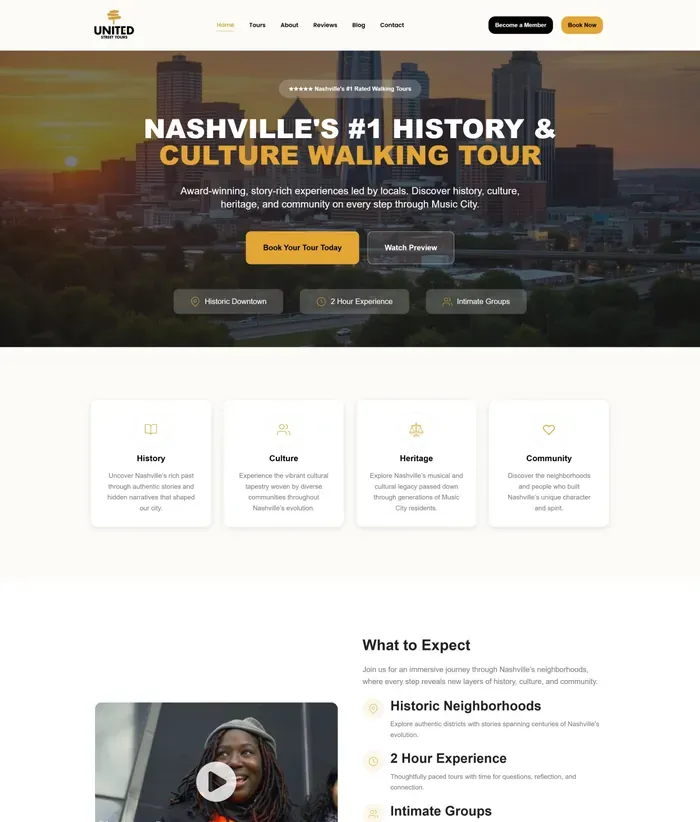
Nashville's #1 history and culture walking tour with booking system and membership portal.
View live site: unitedstreettours.comHow we work
Every project follows the same four-phase process. You always know what week you are in, what is being delivered, and what we need from you. Fixed timeline, fixed price, in writing before we start.
DELIVERABLES
We audit your current site for Core Web Vitals, schema gaps, and local SEO issues. We map your ministry structure (service times, campuses if applicable, key programs) and identify the queries people in your area are using to find a new church home. You receive a written strategy document covering page structure, local SEO priorities, and giving integration recommendations.
DELIVERABLES
We use AI-assisted design to generate and refine your homepage and key section pages, built around your congregation's identity and the local competitive landscape. Simultaneously, we map your ministry pages, sermon archive structure, and event calendar architecture. You review both in one consolidated feedback round.
DELIVERABLES
Approved designs go into WordPress on our performance stack. We build your giving integration, sermon archive with custom taxonomies, event calendar with Google Calendar sync, and ministry directory. Church and Event schema markup is implemented on every relevant page. Staff training documentation is written as we build.
DELIVERABLES
We handle DNS cutover, 301 redirect mapping from your old URLs, and sitemap submission to Google Search Console. Your Google Business Profile is audited and fully optimized: denomination, service times, photo metadata, Q&A. You receive a video walkthrough and a 30-day post-launch monitoring window.
Most churches are live within 9 weeks of their first call. No retainer required after launch.
Transparent pricing
Every tier is fixed price, fixed scope, fixed timeline, defined in a written statement of work before we invoice a dollar. No hourly billing. No surprise line items for additional revisions. You know exactly what you are buying and when it will be done.
All tiers available with a monthly care plan from $150/month: WordPress updates, weekly backups, uptime monitoring, and priority support within 4 business hours.
Complete guide
Everything a congregation leader or church administrator needs to know before commissioning a new church website: from online giving integration to sermon archives to local SEO for faith-based organizations in Maryland.
Worship website design for Maryland churches starts with a fundamental distinction: a ministry website serves a different purpose than a business site. Whether you're building a small church website for a 50-member congregation or a full-featured platform for a multi-campus ministry, the goals are community, connection, and trust rather than conversion funnels and lead capture. Churches face a web design challenge that no other organization type does: the same website must serve three completely different audiences simultaneously. Current members need practical tools: service times, event registrations, online giving, sermon replays, and ministry sign-ups. Prospective visitors are searching for a faith community and evaluating whether your congregation is a cultural fit before they ever walk through your doors. The broader Maryland community discovers your church through local search results when they search for food pantries, counseling resources, or community events. A single website must speak authentically to all three groups without diluting the message for any of them.
This multi-audience requirement drives every design decision for church websites. Navigation must surface practical tools (give, events, watch online) while also providing the warm, community-oriented first impression that helps a searching family understand your church's personality. Content must be fresh enough to show an active congregation. A church website with 2023 event dates signals abandonment more powerfully than no website at all, while timeless information about your beliefs, your history, and your ministries provides lasting value. And the technical foundation must support live streaming, media storage, and donation processing without requiring a full-time technical staff to maintain.
Church websites accumulate pages over years of incremental additions without anyone auditing whether the overall structure still serves visitors effectively. The most common problem is a navigation menu with 15+ items, many of which lead to pages that haven't been updated since 2021. A complete church website needs a specific set of essential pages, each with a clear purpose, and a disciplined editorial approach to keep them current. Everything else (the ministry-specific subpages, the archive pages, the historical content) should be organized below the main navigation so it doesn't obscure the high-priority paths.
For a Maryland church, the essential page set reflects both congregational life and local search behavior. "Churches near me" searches in Google return results based on your Google Business Profile and website content. "Christmas Eve services Baltimore" searches return results based on your events content and location pages. Your page architecture needs to support both the member who visits the site daily and the Google crawler that determines whether you appear in searches from people who have never heard of your congregation.
Google's structured data guidelines include a specific schema type for churches: Church, which is a subtype of LocalBusiness. Implementing JSON-LD schema on your Maryland church website tells Google's knowledge graph that your organization is a religious institution with specific attributes (denomination, service times, languages spoken, and physical location) that are relevant to local search queries. Without this schema, Google must infer these attributes from your page text, which produces inconsistent results and incorrect information in knowledge panels.
Church schema implementation for Maryland congregations should include the organization's legal name (as registered with Maryland's State Department of Assessments and Taxation), the denomination or affiliation, service schedule in OpeningHoursSpecification format, all contact methods, GPS coordinates, and a high-resolution exterior photo. For multi-campus churches in the Baltimore, Annapolis, or DC metro areas, each location needs its own Church schema node with its own address and service schedule, linked to a parent Organization entity representing the overall ministry.
Online giving represents the fastest-growing segment of church revenue for Maryland congregations, with the percentage of online giving processed digitally increasing from 28% in 2019 to 61% in 2024 among churches with giving platform integrations. The platform choice matters because each has different fee structures, different features, and different levels of integration with WordPress. Getting this decision wrong means either losing a percentage of every donation to fees, dealing with a clunky giving experience that discourages use, or managing giving data in a system that doesn't connect to your church management software.
Tithe.ly and Pushpay are the two dominant platforms for Maryland churches, covering the majority of evangelical and nondenominational congregations. Tithe.ly charges 2.9% + $0.30 per card transaction and has a WordPress plugin that embeds directly in any page. Pushpay targets larger congregations and includes church management software alongside the giving platform. For Catholic parishes and mainline Protestant churches, ParishSoft (now part of ACS Technologies) and Vanco are common choices because of their denominational integrations. For very small congregations, Stripe with GiveWP is the most cost-effective option.
The sermon archive is the most visited section of a church website by members, yet it receives the least design attention of any major section. A well-designed sermon library serves three functions: it gives regular attenders a way to re-watch or share sermons they've heard, it provides a searchable resource for members who want to find teaching on specific topics or Bible passages, and it serves as the primary content marketing channel for churches seeking to attract new members through YouTube, podcast platforms, and social media. Churches that invest in their sermon archive see 30-45% of their online traffic coming directly to sermon pages, from people who have never attended in person.
Maryland churches that maintain strong sermon archives are also building significant content equity: a church with 10 years of weekly sermon content has thousands of pages of original theological teaching, each of which can attract search traffic on specific biblical and theological questions. The key is proper tagging and categorization from the beginning: by sermon series, by Scripture passage, by topic (marriage, finances, parenting, anxiety), and by speaker. Without this structure, the archive becomes a chronological list that only serves people looking for a specific date.
Church events calendars are notoriously difficult to maintain because they involve multiple stakeholders (youth ministry, women's ministry, men's ministry, facilities team) all adding events independently, with inconsistent formatting and missing details. The technology problem is secondary to the process problem: most church calendars become messy not because the platform is wrong, but because there's no clear ownership and no standard template for event entries. The best calendar platform in the world becomes useless if half the events are missing their address, description, or registration link.
For WordPress-based Maryland church websites, The Events Calendar (by Modern Tribe) is the dominant plugin choice, with over 900,000 active installations. Its free version handles recurring events, multiple categories, and basic calendar and list views. The Events Calendar Pro adds additional views (week, month, day), venue management, organizer profiles, and integration with event management platforms. For churches that host large community events like VBS, conferences, and fundraisers, Eventbrite integration brings paid ticketing and RSVP management directly into the WordPress calendar display.
The ministries section of a church website is where most congregation members go when they're looking to get more involved, and it's where church websites fail most spectacularly. A list of ministries with generic descriptions and "contact the church office for more information" as the only call to action communicates that the congregation is insular and not actively seeking new participants. Effective ministry pages function as recruitment tools: they describe specifically who the ministry is for, what the time commitment looks like, what impact participation has on members' lives, and exactly how to take the next step toward joining.
Small group systems deserve particular attention because small group participation is the strongest predictor of long-term church retention. Members who are in a small group are 4x more likely to remain connected to the congregation over a 3-year period than those who only attend Sunday services. A small group finder that lets visitors filter by day, time, neighborhood, life stage, or topic significantly reduces the friction between "I want to connect" and "I'm in a group." Many Maryland churches lose potential small group members simply because the connection process is unclear or requires filling out a form and waiting for a call back.
Your church live streaming website setup is no longer optional for Maryland congregations. Live streaming became a baseline expectation during 2020 and has remained so. Members who travel frequently, those with mobility limitations, those caring for sick family members, and those visiting from out of state all rely on livestream access to remain connected to their church community. Beyond the existing congregation, live streaming is also the primary way prospective attenders preview a church before committing to an in-person visit. That reality changes how you should think about the production quality and on-screen presentation of your services.
The most common live streaming setup for Maryland churches in the 100-500 weekly attendance range involves YouTube Live as the primary streaming destination, embedded on the church website through a dedicated Watch Live page. YouTube Live is free, handles unlimited concurrent viewers, and automatically archives the stream as a YouTube video that becomes the source material for the sermon library. For churches that want more control over the viewing experience or need to restrict access, Vimeo Livestream and BoxCast are popular alternatives. The website integration requires a dedicated Watch Live page that shows the live video when a service is in progress and the most recent archived sermon when it isn't.
As Maryland congregations grow beyond 150 members, coordinating volunteers across multiple ministries with spreadsheets and email chains becomes unmanageable. The website's role in volunteer management is to be the front door of the volunteer pipeline: a Serve page that explains the ministry areas that need volunteers, forms that capture volunteer interests and availability, and a system that routes that information to the right ministry leaders without requiring the church office to manually forward every submission. The deeper volunteer management work (scheduling, tracking, communication) happens in a dedicated church management system (ChMS), but the website is where the volunteer journey begins.
Planning Center is the dominant volunteer management and church management platform for evangelical and nondenominational Maryland churches, covering service scheduling, group management, donation tracking, and communication. Breeze ChMS is a popular budget-friendly alternative for smaller congregations. Both integrate with WordPress through form connections and embed codes that surface volunteer opportunities and team sign-ups directly on the church website. The key integration point is ensuring that a visitor who fills out a "I want to serve" form on your website ends up in the right place in your ChMS within 24 hours, without requiring manual data entry by staff.
Local SEO for Maryland churches operates differently than for businesses because the primary search intent is community affiliation, not transactional. Someone searching "Baptist church near me in Annapolis" isn't comparison shopping on price. They're looking for a faith community that fits their beliefs, culture, and schedule. The local SEO work for churches therefore focuses on visibility (appearing in map results and local organic results), trust signals (reviews, active Google Business Profile, consistent NAP data), and differentiation (communicating your church's specific culture and theological position through content).
Google Business Profile is the single highest-impact local SEO action for Maryland churches. A fully optimized GBP with your denomination, service schedule, photos of your sanctuary, congregation, and pastoral team, and 20+ Google Reviews will place you in the local map pack for "[denomination] church [city Maryland]" searches. The website supports this by providing consistent NAP (Name, Address, Phone) information on every page, Church schema markup, and location-specific content that mentions your Maryland city, county, and neighborhood naturally throughout the site copy.
Churches have a theological and practical reason to prioritize web accessibility that goes beyond legal compliance: their mission is to welcome everyone, and a website that is inaccessible to blind visitors, deaf visitors, or visitors with cognitive disabilities directly contradicts that mission. The practical reality is that ADA Title III accessibility requirements have been applied to websites in federal court, and nonprofits (including religious organizations) are not exempt from these requirements in digital contexts. A church website that fails basic WCAG 2.1 Level AA standards creates both a ministry failure and a legal exposure.
Accessible church website design for Maryland congregations starts with the same WCAG fundamentals that apply to any website (sufficient color contrast, keyboard navigability, screen reader compatible markup) but also includes church-specific considerations: sermon video captions, audio descriptions for visual worship elements, accessible giving forms with clear error messages, and event registration forms that work with assistive technologies. Many Maryland churches are also serving multilingual communities; adding a Spanish-language version of at least the key visitor pages (service times, I'm New, Contact) dramatically expands accessibility for Maryland's significant Hispanic community.
Church website design is a specialized niche within web design, and not every web designer who says they serve churches actually understands what makes a church website work. The most common mistake Maryland churches make when hiring a web designer is choosing based on portfolio aesthetics alone. A beautiful design doesn't help your congregation if it was built on a platform your office manager can't update, if it doesn't integrate with your giving platform, or if it has no sermon archive system. The right designer for a Maryland church needs to understand congregation lifecycle, content governance for volunteer-maintained sites, and the specific integrations your ministry operations require.
The budget reality for Maryland churches: a professionally designed WordPress church website with all the essential functionality (giving integration, event calendar, sermon library, live stream embed, basic SEO setup) costs between $3,500 and $8,000 as a one-time build, plus hosting and a care plan for ongoing maintenance. Platforms like Squarespace Church and Wix offer lower initial costs but create long-term constraints on functionality and ownership that many growing Maryland churches regret within 3-5 years. WordPress built on your own hosting gives you full control of your content, your domain, and your data permanently.
How we compare
Maryland churches have four common website options. Giving integration, sermon archive functionality, and content ownership determine which one serves your congregation long-term.
| Factor | Upcoming Brand (WordPress) | Church Center / Breeze | Wix / Squarespace | Church template theme |
|---|---|---|---|---|
| Church schema control | Full JSON-LD: Church, Event, Organization | Platform-controlled | No custom JSON-LD | Generic schema only |
| Online giving integration | Tithely, Pushpay, Stripe, PayPal | Built-in platform only | Basic PayPal link | Varies |
| Sermon archive with search | Custom taxonomy: topic, scripture, speaker | Basic media library only | No archive functionality | Rarely implemented |
| Monthly cost after launch | $150/month care plan | $12-$75/month platform | Platform fee only | $100-$300 hosting + support |
| Core Web Vitals | Guaranteed green on delivery | Platform average | Substandard | Depends on theme |
| Event calendar with schema | EventSchema markup | Basic listing | No schema support | Basic calendar |
| Local search visibility | High (Church schema + GBP) | Moderate | Low (no schema) | Low to moderate |
Every build includes
No add-on fees for the fundamentals. Every church website design project ships with the complete stack at one fixed price.
Transparent pricing
A custom WordPress website for a Maryland church costs between $1,500 and $5,000 for most congregations. Multi-campus churches and ministry networks start at $5,000. Every quote is fixed-scope - one price, no hourly surprises.
Need to spread the cost? Use our payment plan calculator. Full pricing breakdown →
The primary lever is Church and LocalBusiness JSON-LD schema on your homepage and contact page, combined with a fully optimized Google Business Profile. Your GBP needs the correct primary category (Religious Organization or the specific denomination), complete service times in the 'Hours' section, a consistent NAP (Name, Address, Phone) matching your website, and at minimum 10+ photos with descriptive file names. We handle all of this as part of every project. Competitive markets like Baltimore may take 3–5 months for consistent Local Pack presence; smaller Maryland markets like Frederick or Salisbury move in 60–90 days.
Tithe.ly is our default recommendation for most churches. It has the best WordPress integration, reasonable transaction fees (about 1% + standard payment processor fees), and supports text giving, recurring pledges, and designated funds out of the box. Pushpay is stronger for larger congregations with complex multi-campus giving or integration with ChMS platforms like Planning Center. If budget is the primary concern, we can build a Stripe-powered custom giving form that has no platform fee, just standard Stripe processing rates. We discuss your congregation size and giving volume during Discovery and recommend the right fit.
That is a core design requirement for every church site we build. Your staff will manage the site through the WordPress admin interface using our custom WordPress web design approach, with Elementor's visual editor for design changes and a structured editorial workflow for sermon posts, event entries, and ministry pages. We provide a plain-English admin manual, a recorded walkthrough video, and a 30-minute live training call with your key staff members. Most church staff are comfortable managing their own content within a week.
We build sermon archives using WordPress custom post types with a taxonomy system covering series, speaker, scripture reference, topic, and date. Past sermons can be migrated from your existing site, a YouTube channel, or a spreadsheet. We handle the import and tagging. The archive includes a filter UI that works on every device and a search field scoped to sermons only. We optimize video embeds as lightweight facades so the archive loads fast regardless of how many entries it contains.
Our WordPress care plan starts at $150/month and covers WordPress core and plugin updates, weekly backups, uptime monitoring, and priority support with a 4-business-hour response window. For churches, we also offer a content add-on that includes one new event series page, ministry page, or location page per month. This compounds your SEO footprint and keeps your site feeling current throughout the church calendar year. Plans are month-to-month, with no annual contract required.
Migration is manageable in most cases. We map your current URL structure, implement 301 redirects for every existing page, and migrate your sermon archive if it's in a format we can export. Church-specific platforms like Clover Sites, Nucleus, or Church Community Builder vary in export quality. We assess your specific platform during Discovery and give you an honest estimate of migration complexity. The most common risk is sermon archive loss, which we mitigate with a content audit before any files are touched.
Church websites · Maryland
★★★★★ 5.0 on Google · 99% Job Success on Upwork
30 minutes · We review your site, your congregation's goals, and tell you exactly what we'd build and what it costs.