Most gym and fitness studio websites lose signups before anyone reads the membership page: slow load times, no class schedule, and a booking form that breaks on phones. We build WordPress sites for Maryland fitness businesses that rank in local search, convert visitors into trial memberships, and give your front desk one less thing to manage. Fixed-scope from $1,500.
Free site audit
We review your current site and send a plain-English audit within 2 business days. No sales call required.
Gym website design is building a custom WordPress website for gyms, fitness studios, CrossFit boxes, and personal training businesses that ranks in Local Pack for membership searches and converts visitors into trial bookings. The build centres on FitnessCenter and SportsActivityLocation schema, class booking integration (Mindbody, Glofox), membership tier pages, and trainer profile pages.
Why members leave before signing up
When someone searches 'CrossFit gym near me in Columbia MD' or 'yoga studio Annapolis,' Google surfaces gyms with complete SportsActivityLocation schema and optimized Google Business Profiles. If your location, hours, class types, and membership options aren't structured for Google to read, you're invisible to people with a credit card ready and a fitness goal in mind, your most valuable prospective members.
Fitness members plan their week around class schedules. If your schedule lives in a PDF, a separate app that doesn't match your site, or a static page that the front desk forgets to update, you're losing bookings to gyms that show live availability. We build class schedule integrations with Mindbody, Glofox, or custom WordPress solutions that stay current without requiring staff intervention.
A free trial offer is the highest-converting fitness CTA, and most gym websites bury it behind a generic contact form, four clicks deep. When your trial form is mobile-optimized, above the fold, and asks for only the essential information (name, email, goal, preferred time), trial signup rates increase 3–5x. We build trial intake forms that connect directly to your CRM or email system and notify your front desk instantly.
What we build into every site
A fitness website is not a brochure. It is a membership acquisition engine. Every element we build, from schema to booking integrations to trial forms, is designed to do one job: turn a searching stranger into a paying member.
Every page receives SportsActivityLocation, FitnessCenter, and LocalBusiness JSON-LD schema covering your gym's disciplines (HIIT, yoga, CrossFit, etc.), hours, location, and membership options. This is what enables Google to show your facility in the local 3-pack for searches like 'personal training studio Frederick MD' and in the fitness-specific results Google shows for workout-related queries. Without this structured data, Google is guessing what kind of business you are.
We integrate your class management system (Mindbody, Glofox, Pike13, or a custom WordPress solution) directly into your site as part of our <a href="/services/wordpress-web-design/">custom WordPress web design service</a>. Members see live availability, instructors, and duration without leaving your branded environment. The schedule is filterable by class type, instructor, and time slot, and works correctly on every device. When classes fill up, the schedule updates automatically. For gyms that want to sell merchandise, supplements, or <a href="/services/woocommerce-development/">membership or online booking</a> directly through the site, we build full WooCommerce-powered solutions.
We design your membership page around one goal: converting a visitor into a trial booking or membership signup. The page hierarchy leads with your strongest offer (free trial, founding member rate, or challenge), surfaces pricing clearly, and places the signup form where mobile visitors see it without scrolling. Multi-step forms with a progress indicator consistently outperform single-page forms for fitness audiences by 40–60%.
Prospective members read trainer bios to decide if your facility is for them. We build trainer pages that lead with credentials, certifications, specialties, and real photography direction, with structured data for each trainer's qualifications. A strong trainer page also ranks independently for trainer-name and specialty searches, capturing referral traffic from former clients who search for their coach at a new location.
Social proof is the strongest conversion driver in the fitness industry. We build transformation galleries and results pages that load fast (optimized images, lazy loading), are filterable by program or goal type, and include proper testimonial schema so Google can display star ratings in search results. Every results page is independently SEO-targeted for searches like 'weight loss program Baltimore' or 'CrossFit results Maryland.'
We guarantee your site launches with green Core Web Vitals scores across LCP, INP, and CLS, or we fix it at no cost before launch. Fitness sites frequently fail these metrics because of large video backgrounds, unoptimized transformation photos, and class schedule embed scripts. Our builds use server-side rendering, WebP images, CDN-delivered assets, and LCP under 2.5 seconds on mobile, including on class schedule pages.
Portfolio spotlight
USA · Fitness & Wellness
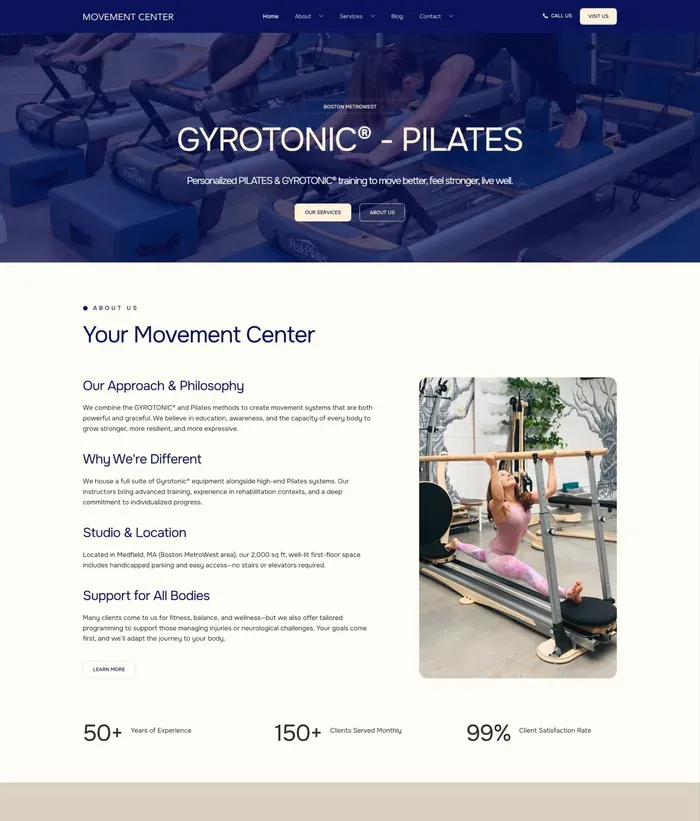
Premium Gyrotonic & Pilates studio with booking integration and instructor profiles.
View live site: movementcenterofmedfield.comHow we work
Every project follows the same four-phase process. You always know what week you are in, what is being delivered, and what we need from you. Fixed timeline, fixed price, in writing before we start.
DELIVERABLES
We audit your current site for Core Web Vitals, schema gaps, and local SEO issues. We map your membership structure: class types, pricing tiers, trial offer. We then identify the queries your target members use to find a gym in your area. You receive a written strategy document covering page architecture, class schedule integration options, and conversion funnel priorities.
DELIVERABLES
We use AI-assisted design to generate and refine your homepage, membership page, and class schedule, built around your gym's brand identity and the local competitive landscape. Simultaneously, we map your trainer bio structure, results gallery, and trial signup flow. You review both in one consolidated feedback round.
DELIVERABLES
Approved designs go into WordPress on our performance stack. We build your class schedule integration, membership and trial signup pages, trainer bios, and results gallery. FitnessCenter and SportsActivityLocation schema is implemented on every relevant page. Your front desk receives a staff training doc as part of the handoff.
DELIVERABLES
We handle DNS cutover, 301 redirect mapping from your old URLs, and sitemap submission to Google Search Console. Your Google Business Profile is audited and fully optimized: gym category, class types, hours, and photo metadata. You receive a video walkthrough and a 30-day post-launch monitoring window where we resolve anything that surfaces.
Most clients are live within 9 weeks of their first call. No retainer required after launch.
Transparent pricing
Every tier is fixed price, fixed scope, fixed timeline, defined in a written statement of work before we invoice a dollar. No hourly billing. No surprise line items for additional revisions. You know exactly what you are buying and when it will be done.
All tiers available with a monthly care plan from $150/month: WordPress updates, weekly backups, uptime monitoring, and priority support within 4 business hours.
Complete guide
Everything a gym owner, studio operator, or fitness facility manager in Maryland needs to know before building or relaunching their website: from class booking integration to membership funnel design to local SEO for the fitness industry.
Good fitness website design for Maryland gyms and studios starts with one question: what does this site need to do? We also specialize in martial arts website design for dojos, BJJ academies, and boxing gyms across Maryland. A fitness facility website has one primary conversion goal that distinguishes it from almost every other business type: getting a potential member through the door for their first visit. That first visit (whether it's a free trial class, a facility tour, or a day pass) is where gym memberships actually start. Everything your website does should be evaluated against whether it moves a prospective member closer to booking that first visit. Site visitors who consume content without taking a clear next step are not converting, regardless of how long they spend on your pages.
This conversion focus shapes the entire architecture of effective gym web design in Maryland. The homepage hero should have a single prominent CTA: "Book a Free Class" or "Claim Your Free Trial." The schedule page should be bookable, not just viewable. The membership page should have a clear comparison of options and a direct signup path, not a "contact us to learn more" dead end. And the entire site should be optimized for the mobile-first behavior of your target audience. Fitness seekers in Maryland increasingly discover gyms through Instagram, Google Maps, and "gyms near me" searches on their phones, and they will not tolerate a desktop-only experience on a 5-inch screen.
Gym website architecture varies significantly by facility type. Yoga studio website design has unique requirements around class scheduling and instructor profiles that differ from a 24-hour big-box gym in Baltimore, which has different needs than a CrossFit box in Rockville. But certain pages are universal across all Maryland fitness facilities, and their absence creates specific conversion problems. A facility without a visible pricing page loses comparison shoppers. A gym without trainer bio pages loses prospects who want to know who will be coaching them. A studio without a class descriptions page loses people who need to understand the format of a class before they'll commit to trying it.
The page set for a complete Maryland gym website should be built with clear progression in mind: a prospective member moves from Homepage (what is this place?) to About or Class Descriptions (is this the right fit?) to Schedule (when can I go?) to Pricing (can I afford this?) to Book/Join (I'm ready). Any friction or dead end in this progression reduces conversion. The pages exist to answer specific questions in a specific order, and they should be designed with that progression explicitly in mind.
Google's structured data vocabulary includes FitnessCenter schema as a specific schema type under SportsActivityLocation, which is itself under LocalBusiness. Implementing FitnessCenter schema on your Maryland gym website gives Google's knowledge graph explicit signals about your facility type, location, operating hours, and services. This directly affects how your business appears in local search results: a properly marked-up gym listing can show hours, star ratings, price range, and "booking available" indicators directly in the search result, before a potential member even clicks through to your site.
For Maryland gyms with multiple locations, a common scenario in the Baltimore and DC metro areas, each location needs its own FitnessCenter schema entity with its own address, phone number, and hours. These individual location entities should be linked to a parent Organization entity representing your gym brand. This multi-location schema structure ensures that Google displays the correct location information in "gyms near me" results regardless of which city a searcher is in. Without it, Google may show the wrong location's phone number or hours for nearby searches.
The class booking platform decision is the most consequential technology choice a fitness studio makes, and it's one that directly affects your website. A booking system that lives entirely on a third-party platform (forcing members to leave your site to book) loses the conversion momentum built by your site's content. A booking widget that embeds directly in your WordPress site keeps that momentum and allows you to maintain brand consistency through the entire booking flow. The major platforms (Mindbody, Glofox, and Pike13) each have different embedding capabilities and different business model fits.
Beyond class booking, gym management software like Mindbody handles billing, staff scheduling, and member retention automations from a single platform. Mindbody is the incumbent market leader with the broadest feature set, but it's expensive ($129-$349/month), and its widgets have a reputation for being slow to load and visually inconsistent with custom WordPress designs. Glofox is the preferred platform for boutique studios and CrossFit boxes, with a cleaner member-facing interface and better mobile app UX for members. Pike13 targets facilities with complex scheduling needs: multiple locations, varied staff schedules, and sophisticated reporting requirements. For smaller Maryland fitness businesses, WooCommerce Bookings or BookingPress provides booking functionality at a fraction of the cost with full WordPress integration.
The membership conversion funnel for a Maryland gym website follows a predictable psychological path: awareness (the visitor discovers your gym through search or social), consideration (they evaluate whether your facility fits their goals, schedule, and budget), and decision (they take the first commitment step). Most gym websites do a reasonable job with awareness, looking professional and showing up in local searches, but fail at the consideration and decision stages by not providing enough specific information and making the first step feel too large.
The most effective conversion technique for Maryland fitness businesses is a low-friction free trial offer as the primary CTA, combined with a high-trust consideration path for visitors who aren't ready to commit immediately. Group fitness classes, personal training, and membership tiers each need their own entry point in the funnel. The free trial (one week, two group fitness classes, or one personal training session) reduces the perceived risk of the first commitment. The consideration path (a detailed FAQ, virtual facility tour, class description videos, and trainer profile pages) gives serious prospects the information they need to overcome their hesitation. The combination of these two elements increases membership inquiry rates by 35-50% compared to a standard "Join Now" CTA alone.
Personal trainer website design requires a different approach than general gym pages because training purchase decisions are almost always relationship-based: members choose trainers they trust, relate to, and believe can help them achieve their specific goals. Personal trainer marketing through your website starts with trainer pages that establish those relationships before a prospective client ever walks through the door. A trainer profile that lists certifications and specialties is functional but forgettable. A trainer profile that tells a genuine story, covering why they got into fitness, what specific transformation they guide clients through, and what makes their coaching style distinctive, creates the beginning of a real connection that drives inquiry and booking.
From an SEO perspective, individual trainer profile pages also capture a valuable segment of fitness searches. Maryland residents who search for "personal trainer specializing in weight loss Baltimore" or "certified strength coach Annapolis" are high-intent prospects. If your trainer's profile page contains these natural phrase combinations alongside genuine content about their approach and expertise, these pages can rank for long-tail searches that your general gym homepage will never capture. Each trainer page functions as both a trust-building conversion tool and a standalone SEO asset.
Transformation galleries are one of the highest-converting content types for fitness businesses, but they require careful handling for both ethical and legal reasons. A well-executed transformation gallery shows genuine member results, includes authentic quotes, and represents the realistic outcomes your training produces. A poorly executed gallery shows stock photo models labeled as members, uses misleading before-and-after framing (unflattering lighting vs. flattering lighting rather than genuine physique change), or features outlier results without appropriate context. Maryland's consumer protection laws apply to fitness marketing; before-and-after content that implies typical results can constitute deceptive advertising if those results are not typical.
The most effective social proof strategy for Maryland fitness businesses combines transformation photos with authentic member stories, Google Reviews with specific detail, and video testimonials that capture emotion alongside results. Video testimonials in particular are highly effective because they're difficult to fake and convey the genuine enthusiasm of satisfied members more powerfully than written text. A gym with 20 genuine video testimonials from real Maryland members will consistently outconvert a gym with a polished professional video production and generic claims about "community" and "results."
The fitness industry is one of the most locally competitive search categories in Maryland. Gym SEO in Maryland means competing in markets like Baltimore, Annapolis, and Rockville where dozens of gyms and fitness studios are targeting the same "gym near me" traffic. Fitness SEO and gym lead generation through Google require a combination of Google Business Profile optimization, consistent local citations, and website content that signals geographic relevance to Google's local algorithm. Without deliberate local SEO work, even an excellent facility with great reviews can be invisible to the majority of its potential market.
Maryland fitness businesses benefit from targeting hyper-local search terms that have less competition than generic "gym" searches. "CrossFit near Federal Hill Baltimore," "yoga studio Annapolis Maryland," "personal training Columbia MD," and "weightlifting gym Bethesda" all have meaningful search volume with significantly less competition than "gym near me." Creating dedicated content pages optimized for these specific local intent queries, either service-area pages or neighborhood-specific landing pages, can drive consistent organic traffic from high-intent prospects who are specifically looking for your type of facility in your geographic area.
Gym and fitness studio websites are among the most image-heavy sites in any industry. Member transformation galleries, instructor action shots, facility photos, class schedule embedded widgets, and video testimonials all create significant page weight that directly impacts Core Web Vitals scores. A fitness website that scores below 50 on Google's PageSpeed Insights mobile test is losing a meaningful percentage of prospects before those prospects ever read a word of your content. Google research consistently shows that 53% of mobile users abandon a site that takes longer than 3 seconds to load.
The performance challenge for fitness websites is compounded by the booking widget: most class booking platforms (Mindbody, Glofox) load significant JavaScript that runs during page initialization, adding 1-3 seconds to the Time to Interactive metric. The best approach is to lazy-load the booking widget only after the main content has rendered, so the visible page content loads immediately while the booking functionality initializes in the background. This requires careful implementation and testing, but it improves mobile Largest Contentful Paint by 40-60% without removing any functionality.
The average gym in the United States loses 50% of its members within the first year. Member retention, keeping members who joined from canceling, is worth significantly more to your business than new member acquisition. A new member costs $50-$150 in marketing and sales effort to acquire. Retaining an existing member costs almost nothing. The website's role in retention gets overlooked because retention is assumed to happen in person, through coaching quality and community. But your website can actively support retention through the resources, tools, and communication channels it provides to current members.
Member-facing website features that improve retention include: a member portal with progress tracking, a class booking history, and easy access to membership management tools; a blog or resource library with workout guides, nutrition content, and recovery information that provides ongoing value beyond the physical training; and event listings for community events (challenges, competitions, social gatherings) that build the social connections that are the strongest predictor of long-term gym retention. Members who participate in gym events and have 3+ gym friendships cancel at one-quarter the rate of members who only attend classes and leave immediately afterward.
Maryland gym operators expanding from one location to two or more face a specific website architecture challenge: how do you maintain a unified brand presence while ensuring that each location's specific information (address, phone number, hours, class schedule, staff) is clearly presented and properly indexed by Google for local search? Getting this wrong leads to either a confusing user experience where visitors can't find their specific location's information, or a local SEO failure where Google consolidates all location signals onto one listing and makes the other locations invisible in local search.
The standard approach for multi-location Maryland fitness businesses is a hub-and-spoke site architecture: a main website with shared brand content (about, philosophy, membership tiers) and dedicated location pages for each physical facility. Each location page functions as a mini-homepage for that location: its own address, phone number, hours, class schedule embed, staff section, and local photography. These location pages need their own LocalBusiness schema markup, their own Google Business Profile linked to them, and their own local citation profile. The main website's domain authority benefits all location pages through internal linking, while each location page independently builds local relevance for its geographic area.
The fitness industry has a specific sub-category of web design agencies that specialize in gym and studio websites. These specialists understand class booking integrations, membership funnel design, and the visual language of fitness brands. However, they sometimes lack the technical SEO depth and WordPress expertise to build a site that performs well in local search over the long term. Conversely, general WordPress agencies with strong SEO capabilities may not understand the specific conversion patterns of fitness businesses. The ideal agency for gym website design Maryland combines fitness industry knowledge with solid WordPress development and local SEO expertise.
Budget expectations for a Maryland gym website: a professionally designed WordPress site with booking integration, local SEO setup, member transformation gallery, trainer profile pages, and a class schedule page costs $3,500 to $7,500 as a one-time build. Ongoing maintenance, including booking platform API updates, plugin maintenance, security, and content updates, runs $150-$300 per month depending on scope. Agencies that quote significantly below this range are delivering template installations with minimal customization that will require significant rework within 18 months as your facility's needs grow.
How we compare
Maryland gyms and fitness studios have four common website options. Booking integration, schema support, and membership conversion architecture determine which fills classes and grows membership.
| Factor | Upcoming Brand (WordPress) | Mindbody / MBO site | Wix / Squarespace | Generic local agency |
|---|---|---|---|---|
| FitnessCenter schema | Full JSON-LD: FitnessCenter, SportsActivity | Platform-controlled | No custom JSON-LD | Generic LocalBusiness only |
| Booking integration | Mindbody, Glofox, Pike13, Calendly | Mindbody embed only | Third-party widget only | Varies |
| Class schedule | Filterable page with schema | Basic listing | Basic embed | Varies |
| Monthly cost after launch | $150/month care plan | $200-$600/month platform | $23-$65/month platform | Retainer $200+ |
| Core Web Vitals | Guaranteed green on delivery | Substandard (bloat) | Acceptable | Depends on template |
| Membership pages + trial CTA | Custom comparison + free trial page | Basic pricing page | Generic pricing table | Varies |
| Local Pack upside | High (schema + GBP + citations) | Moderate | Low (no schema) | Low to moderate |
Every build includes
No add-on fees for the fundamentals. Every gym and fitness website design project ships with the complete stack at one fixed price.
Transparent pricing
A custom WordPress website for a Maryland gym or fitness studio costs between $1,500 and $6,000 for most single-location facilities. Multi-location gyms and franchise networks start at $6,000. Every quote is fixed-scope - one price, no hourly surprises.
Need to spread the cost? Use our payment plan calculator. Full pricing breakdown →
The primary lever is FitnessCenter and SportsActivityLocation JSON-LD schema on your homepage combined with a fully optimized Google Business Profile. Your GBP needs the correct primary category (Gym or the specific type, such as 'Yoga Studio' or 'CrossFit Gym'), complete hours, consistent NAP matching your website, and photos of your actual facility with descriptive file names. We handle all of this as part of every project. In competitive Maryland markets like Baltimore or Bethesda, expect 3–5 months for consistent Local Pack presence. Smaller markets like Frederick or Salisbury move in 60–90 days.
For studios under 200 members, Glofox or Pike13 offer the best balance of features and cost: clean WordPress integrations, reasonable monthly fees, and solid mobile apps for members. For larger facilities or multi-location operations, Mindbody is the industry standard despite its complexity and higher cost. If you're an independent personal trainer or small studio and cost is the primary concern, we can build a booking flow using Calendly or Acuity integrated into your WordPress site at no platform fee beyond your subscription. We assess your situation during Discovery.
That is a core design requirement for every gym site we build. Pricing tables, class schedules (if using a custom WordPress solution), promotional banners, and blog posts are all editable through the WordPress admin with no code required. If you're using Mindbody or Glofox, schedule updates happen in your booking system and sync to the site automatically. We provide a plain-English admin manual, a recorded walkthrough video, and a 30-minute live training call with your key staff members.
The offer should appear on your homepage above the fold, on a dedicated trial landing page, and as a sticky banner or CTA on class schedule and pricing pages. The trial form should ask for 3–5 fields maximum: name, email, fitness goal, and preferred class time. Multi-step forms, where you split the form across two screens, consistently outperform single-page forms for fitness audiences. We build the form with instant email notification to your front desk and optional integration with your CRM or email marketing platform.
Our WordPress care plan starts at $150/month and covers WordPress core and plugin updates, weekly backups, uptime monitoring, and priority support with a 4-business-hour response window. For gyms, we also offer a content add-on that includes one new class landing page, trainer bio, or transformation results page per month, compounding your SEO footprint over time as your program offerings expand. Plans are month-to-month with no annual contract required.
The project runs 8–9 weeks from first call to live site, with minimal disruption if the migration is handled correctly. We map your current URL structure, implement 301 redirects for every existing page, and migrate your blog content and testimonials. Class schedule data from your booking system is not migrated (that lives in Mindbody or Glofox), but the integration configuration is set up fresh. The most common concern is losing existing Google rankings. With a proper redirect map, any ranking dip from a clean migration recovers within 4–6 weeks.
Gym & fitness websites · Maryland
★★★★★ 5.0 on Google · 99% Job Success on Upwork
30 minutes · We review your site, your membership funnel, and tell you exactly what we'd build and what it costs.