Most nonprofit websites lose donors before the first gift: slow load times, broken donation forms, and copy that never explains the impact. We build WordPress sites for Maryland nonprofits that rank for cause-related searches, integrate with GiveWP or Stripe, and turn visitors into donors and volunteers. Fixed-scope from $1,500.
Free site audit
We review your current site and send a plain-English audit within 2 business days. No sales call required.
Hit 91 on PageSpeed and ranked page one for three practice area keywords.
New patient online bookings went from 4 a month to 19 within 90 days.
Google Local Pack calls started within 6 weeks of going live.
Nonprofit website design is building a custom WordPress website for 501(c)(3) organisations, foundations, and charitable missions that converts visitors into donors, volunteers, and grant-maker contacts. The build centres on NGO and NonprofitOrganization schema, GiveWP or Stripe donation processing with recurring giving, WCAG 2.2 AA accessibility compliance, and impact storytelling architecture.
Why donors leave before giving
73% of donors research nonprofits online before making a gift, and a one-second delay in donation page load time reduces conversions by 7%. Most nonprofit websites we audit load in 6–9 seconds on mobile, which means a donor arriving from an email campaign abandons before they see your Give button. Every second of friction is a gift that doesn't happen.
Without NonprofitOrganization and Organization JSON-LD schema, Google cannot confidently surface your organization in Local Search, Knowledge Panels, or Google for Nonprofits discovery paths. Generic web agencies don't implement this markup, leaving your organization invisible to donors who are specifically searching for nonprofits in your cause area.
A PayPal button is not a donation system. Donors expect online giving with credit cards, ACH, and recurring gift options, including a tax receipt confirmation. If your donation process requires more than three clicks or redirects to a third-party site with no branding, you're losing first-time donors before they become recurring supporters.
What we build into every site
A nonprofit site is not a brochure. It is your primary fundraising infrastructure. Every element we build, from schema to donation forms to impact copy, is designed to do one job: turn a visiting stranger into a donor, volunteer, or recurring supporter.
Every page receives NonprofitOrganization and Organization JSON-LD markup: mission statement, cause category, geographic service area, EIN, and donation links. This tells Google exactly what your organization does and who it serves, enabling visibility in cause-specific searches and Google's Nonprofit program pathways.
We integrate GiveWP, Stripe, or your preferred donation platform directly into your site as part of our <a href="/services/wordpress-web-design/">custom WordPress web design</a> service. Donors can give one-time or set up recurring gifts without leaving your domain, in a form that matches your brand. We configure donation tiers with impact descriptions, set up automatic tax receipt emails, and ensure the giving flow works on mobile, where most impulse donations happen. For nonprofits that need a full-featured <a href="/services/woocommerce-development/">online donation system</a> with recurring billing and donor management, we can also build WooCommerce-powered giving solutions.
Donors give to stories, not statistics. We build program impact pages that lead with specific outcomes (people helped, meals served, students funded) and support them with data, photography direction, and structured calls to action. Impact pages that tell specific, measurable stories convert at 2–3x the rate of generic 'about our mission' pages.
Beyond donations, nonprofits need volunteers and event attendees. We integrate volunteer signup forms with Volunteer Local or a custom WPForms system, and build event pages with registration capability. Every signup is connected to your email list so volunteers and attendees stay engaged with your organization's work.
Appearing in local search for your cause, such as 'food bank Baltimore' or 'scholarship foundation Annapolis', drives awareness and donations from people actively searching for nonprofits to support. We audit and optimize your GBP with correct nonprofit categories, service areas, and program descriptions. We also set up your Google for Nonprofits account if you haven't enrolled.
We guarantee your site ships with green Core Web Vitals, or we fix it before launch at no cost. Nonprofit sites with large image files, embedded social feeds, and outdated themes routinely fail these benchmarks. Donation page performance directly impacts conversion rates, so we optimize every page on the giving path using <strong>Core Web Vitals</strong> as our benchmark.
Portfolio spotlight
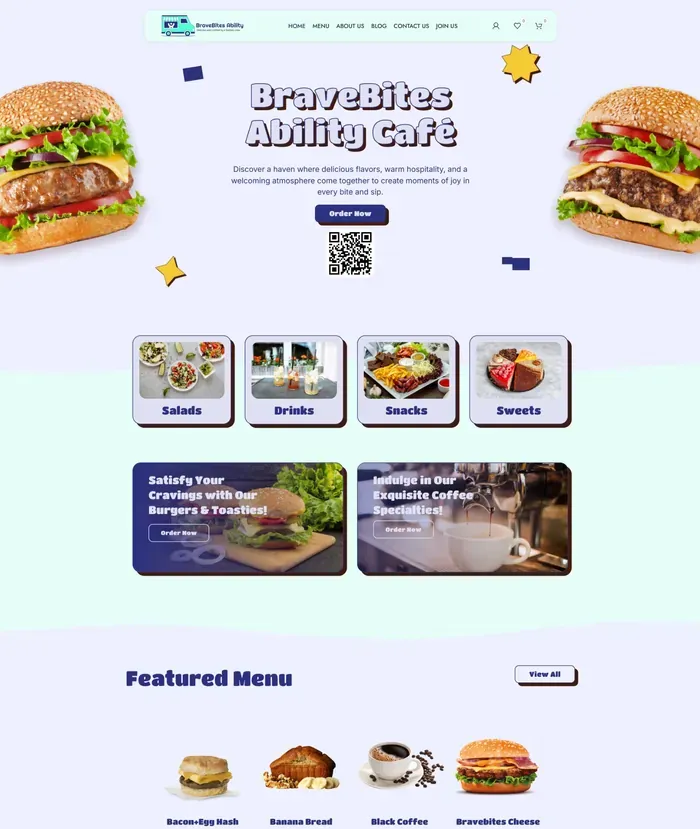
Australia · Restaurant
Healthcare café website with QR code ordering, vibrant menu design, and online orders.
View live site: bravebitesability.comHow we work
Every project follows the same four-phase process. You always know what week you are in, what is being delivered, and what we need from you. Fixed timeline, fixed price, in writing before we start.
DELIVERABLES
We audit your current site for technical SEO, Core Web Vitals, donation friction, and schema gaps. We map the complete donor journey: how people find you, what they read, and where they abandon before giving. You receive a written strategy document covering gaps, page recommendations, and giving flow improvements.
DELIVERABLES
We generate your homepage, program pages, and donation experience using AI-assisted design, mission-forward and built around your brand. We draft all copy: impact narratives, program descriptions, and giving tier descriptions. One consolidated feedback round.
DELIVERABLES
Approved designs go into WordPress. GiveWP or Stripe donation integration is configured with recurring gift options and tax receipt automation. Every page gets NonprofitOrganization schema. Volunteer signup and event pages are built and tested.
DELIVERABLES
We handle DNS cutover, 301 redirects, and sitemap submission. Your GBP and Google for Nonprofits account are set up or audited simultaneously. You receive a handoff video and 30-day post-launch monitoring window.
Most clients are live within 8 weeks of their first call. No retainer required after launch.
Transparent pricing
Every tier is fixed price, fixed scope, fixed timeline, defined in a written statement of work before we invoice a dollar. No hourly billing. No surprise line items. You know exactly what you are buying and when your donation platform goes live.
All tiers available with a monthly care plan from $150/month, covering WordPress updates, weekly backups, uptime monitoring, and priority support within 4 business hours. Discounted rates available for 501(c)(3) organizations.
Complete guide
Everything Maryland nonprofits, foundations, and mission-driven organizations need to know about building a website that drives donations, attracts volunteers, and communicates mission impact clearly to every audience.
A commercial website exists to convert a single audience (a buyer) toward a single outcome: a purchase. A nonprofit website must serve five distinct audiences simultaneously, and each arrives with fundamentally different intentions. Donors want to understand whether their money will be used effectively. Volunteers want to know what the experience will be like and whether their time will matter. Program recipients need to find services and understand eligibility. Grant-makers are conducting due diligence on organizational credibility and program outcomes. Board members and community partners are assessing organizational stability. Designing a website that serves all five groups without diluting the message for any one of them is the central challenge that makes nonprofit web design a distinct discipline.
Unlike a business site where every page ultimately funnels toward a transaction, a nonprofit site must balance three parallel conversion goals: donations, volunteer enrollment, and calls to action such as petition signatures, event registrations, or program intake forms. The homepage hierarchy must communicate mission before it ever asks for money. Donors who feel emotionally connected to the mission before they see a donate button give at significantly higher rates than donors who are pushed toward a transaction the moment they land on the site.
Impact storytelling is the mechanism that creates that emotional connection. The nonprofit sites that consistently outperform their sector peers in online fundraising are built around stories about real people whose lives changed because of the organization's work. Not statistics alone, not mission statements. Stories. When a donor can picture a specific person helped by a specific program, the psychological distance between intention and action collapses. That is the architecture a nonprofit site must be built to support. Effective nonprofit digital marketing through content, schema, and storytelling all flow from this same foundation.
Grant-makers evaluate nonprofit websites with extraordinary attention before recommending funding. Many foundations now require program officers to review an organization's website as part of the due diligence process. They are looking for mission clarity, evidence of program activity, financial transparency, governance structure, and professional credibility. A nonprofit that cannot communicate these qualities through its website is at a structural disadvantage in competitive grant cycles, regardless of the quality of its programs on the ground.
The data on major gift donors is particularly striking. Research from Blackbaud and the Association of Fundraising Professionals consistently shows that a substantial majority of major gift donors (individuals making multi-year commitments in the five-figure range and above) visit a nonprofit's website before making that commitment. They are looking for proof that the organization is credible, transparent, and mission-aligned. A website that feels outdated, loads slowly, or buries financial accountability documents is quietly killing major gift relationships before the development team ever gets on the phone.
The content hierarchy of a nonprofit site reflects this reality. Mission and impact should lead every page. Navigation should make it trivially easy to find programs, donate, volunteer, and learn about the organization's leadership. The donate button should be present but never predatory. It should feel like a natural invitation, not a commercial transaction. Schema markup for NonProfitOrganization signals organizational legitimacy to Google and helps mission-related searches surface the right results. Every structural decision on a nonprofit website should be evaluated through the lens of trust, and trust is built through clarity, transparency, and evidence of real-world impact.
Most nonprofit websites grow organically over time: a board member adds a page here, a communications intern adds a page there, and the result is a site that has accumulated content without a deliberate architecture. Before any design work begins, every Maryland nonprofit should audit its site against a core page inventory that addresses every audience it needs to serve and every goal it needs to achieve online.
The homepage carries more weight on a nonprofit site than on almost any other type of website. It must communicate mission within the first screenful of content, present a primary call to action (donate or get involved), and surface enough evidence of impact (program statistics, beneficiary numbers, years of service) to give a first-time visitor the confidence to explore further. Maryland nonprofits that hide their mission statement in the About section and lead their homepage with a rotating photo slider are losing donors in the first ten seconds of every visit.
The About page is the second most visited page on most nonprofit sites, and it is doing significant work for multiple audiences simultaneously. For donors, it establishes organizational credibility. For grant-makers, it signals governance structure and institutional stability. For potential staff and volunteers, it communicates culture. A strong About page includes mission, vision, organizational history, a brief explanation of how the organization is governed, and links to leadership bios and financial transparency documents.
Programs and services pages are among the most strategically underinvested areas of nonprofit web presence. Each program deserves its own dedicated page, not a collapsed section on a single programs overview. Individual program pages create searchable, indexable content that surfaces in both donor and beneficiary searches. They also provide the structured program description that grant applications frequently request, making a well-built programs section a genuine operational asset beyond its marketing function.
The donation page deserves its own full design treatment, not a generic embed of a third-party form. The volunteer page should answer the questions a prospective volunteer actually has, such as what is the time commitment, what skills are needed, and what will the experience be like, rather than simply saying "join us." The impact and annual report page functions as a year-round fundraising asset when structured correctly. The board of directors page is a transparency signal that both major donors and grant-makers evaluate closely. Contact pages should list specific staff contacts with actual email addresses rather than routing everything through a generic contact form.
Schema markup is structured data embedded in a website's HTML that tells search engines precisely what an organization is, what it does, and how to represent it accurately in search results. For nonprofit website design Maryland, implementing the correct schema is a technical SEO step with direct implications for donor trust, search visibility, and the accuracy of how the organization appears in Google's Knowledge Panel.
The primary schema type for charitable organizations is NonProfitOrganization, which extends from the broader NGO type in the Schema.org vocabulary. The fields that matter most for Maryland nonprofits include the legal organization name exactly as it appears on the IRS determination letter, the physical address, telephone number, a clear description of the organization's mission and work, the founding date, the number of employees or full-time staff, the geographic area served, and the EIN (tax identification number). That last field, the EIN, is more important than most organizations realize. When a donor or grant-maker searches for a nonprofit's EIN to verify its status on Candid or the IRS Tax Exempt Organization Search, accurate schema ensures that search results for the EIN return the correct organization. In Maryland's nonprofit sector, where multiple organizations sometimes have similar names, EIN accuracy in schema prevents confusion that can redirect donor intent.
Beyond the core organization schema, nonprofits should implement Event schema for every fundraiser, community event, and program activity that has a public-facing date and location. Event schema enables rich results in Google Search: the event date, location, and ticket information can appear directly in search results, increasing click-through rates for fundraising events significantly. Google also surfaces events in the dedicated Events tab in Search, which is a high-intent discovery channel for community-based organizations.
Google's Knowledge Panel (the information card that appears on the right side of search results when someone searches for a specific organization) is populated primarily from structured data and Google's own data sources. For established nonprofits with consistent schema implementation and a verified Google Business Profile, the Knowledge Panel surfaces donation links, key staff contacts, hours of operation, and related news. Nonprofits that have not implemented schema or claimed their Knowledge Panel are missing a free, high-visibility channel for donor acquisition.
Verifying schema implementation is simple: Google's Rich Results Test at search.google.com/test/rich-results accepts a URL and returns a complete audit of the structured data it detects, including any errors or warnings. Every nonprofit website build should include a schema verification step before launch, and schema accuracy should be reviewed annually as organizational details change. Staff turnover, address changes, and program evolution can all cause schema to drift out of alignment with actual organizational facts, and inaccurate schema erodes the donor trust it was designed to build.
A donation website for Maryland nonprofits needs more than a basic payment form. The donation page is the most important conversion page on a nonprofit website, and it is also the page most frequently treated as an afterthought. A generic donation page (a single text field asking for an amount, no impact context, redirecting to a third-party platform with different branding and a URL the donor does not recognize) loses gifts at every stage of that experience. Donors who reach a donation page are already motivated to give; bad design is the reason they do not complete the transaction.
High-converting donation pages are built around a specific set of design principles. Suggested giving amounts with concrete impact equivalents, such as "Give $25 / Provides one week of after-school meals for a student," outperform open-amount fields because they eliminate the cognitive work of deciding what an appropriate gift is. When donors can see exactly what their money does, they are more likely to give and more likely to give at a higher level than they originally intended. The suggested amounts should be based on actual program costs, not round numbers that feel arbitrary.
The recurring versus one-time giving toggle is one of the highest-leverage design elements on a donation page. Monthly recurring donors are the financial foundation of sustainable nonprofit operations. They have higher lifetime value, lower acquisition cost, and provide reliable revenue for program planning. This directly compounds donor retention over time. Placing the recurring option as the default selection, or at minimum as the visually prominent option, consistently increases sustainer acquisition rates. Most donation platforms support this configuration natively.
Maryland nonprofits have several solid donation platform options. Donorbox is widely used and integrates cleanly into WordPress with minimal branding disruption. Classy offers more sophisticated campaign management for organizations with complex fundraising operations. Bloomerang, Little Green Light, DonorPerfect, and Salesforce Nonprofit are donor management platforms that include embedded donation forms and provide the added benefit of syncing donor records directly into the CRM. Stripe with a custom-built form offers the highest level of brand continuity but requires development investment. The right choice depends on budget, CRM integration needs, and the volume and complexity of fundraising activity.
Friction reduction at the payment step is critical. Every additional required field costs conversions. Apple Pay and Google Pay integrations eliminate the need to enter card details on mobile devices, and since more than half of nonprofit donation traffic now arrives on mobile, removing that friction translates directly to higher completion rates. The post-donation experience, including the thank-you page and the automated thank-you email, should be designed with the same care as the donation form itself. A well-designed thank-you sequence reinforces the donor's decision, provides a tax receipt, and plants the seed for the next gift.
Volunteer recruitment pages are among the most underinvested sections of most nonprofit websites. Many organizations treat the volunteer page as a single form ("Sign up to volunteer" followed by name and email fields) with no context about what volunteering actually involves, what impact it creates, or why someone should give their time to this organization rather than any other. That approach performs poorly because it asks for a significant commitment, a person's time, without providing the information that makes that commitment feel worthwhile and manageable.
Prospective volunteers arrive at a volunteer page with very specific questions. What is the actual time commitment, is this a one-Saturday event or a recurring weekly obligation? What skills or qualifications are needed, can anyone help or is specialized knowledge required? What will the experience actually be like, will I be doing meaningful work or stuffing envelopes? How do I apply, and what happens after I submit a form? How quickly will I hear back? A volunteer page that answers all of these questions directly and specifically will out-recruit a page that vaguely invites people to "make a difference" every time.
Individual volunteer opportunity pages, one page per distinct volunteer role or opportunity, significantly outperform a single generic volunteer page for organizations with multiple program areas. A volunteer opportunity page for a tutoring program targets a completely different person than one for a food pantry shift or a board committee opening. Separate pages allow for specific messaging tailored to each opportunity's actual requirements and appeal, and they create distinct URLs that can be shared in targeted outreach campaigns.
Volunteer application forms should be structured to both qualify applicants and route them to the appropriate program coordinator. A form that collects availability, relevant skills, program interests, and any required background check consent saves significant staff time compared to a generic sign-up that requires a follow-up conversation to gather the same information. The form design should signal that the organization is organized and respectful of the volunteer's time from the very first interaction.
Integration with volunteer management platforms enables organizations to move beyond spreadsheets and email threads. VolunteerHub, Galaxy Digital, Better Impact, and SignUpGenius each serve different organizational sizes and complexity levels. The website integration should feel seamless: the volunteer applies on a page that matches the nonprofit's branding, and the data flows directly into the management platform without the volunteer experiencing the handoff.
Current volunteer testimonials are high-converting assets on recruitment pages. A specific, first-person account of what volunteering with the organization was like (the work itself, the relationships formed, the sense of contribution) is far more persuasive than any copy the organization writes about itself. Video testimonials perform particularly well when embedded natively or via an optimized Vimeo embed that does not slow down page load. The combination of an honest, specific description of the opportunity and an authentic volunteer story removes the two biggest barriers to signup: uncertainty and skepticism.
Nonprofit SEO and Google Ad Grants work together as the two primary drivers of organic and paid search visibility for mission-driven organizations. Google Ad Grants provides eligible nonprofits with up to $10,000 per month in free Google Ads search advertising. For Maryland nonprofits with strong websites and well-structured campaigns, this represents a recurring annual advertising value of $120,000, an extraordinary resource that most nonprofits use far below its potential or fail to maintain eligibility to use at all. The quality of a nonprofit's website is a direct determinant of how much value it can extract from Ad Grants.
Eligibility requires 501(c)(3) status recognized by the IRS, enrollment in Google for Nonprofits, and a website that meets Google's quality requirements. Government entities, hospitals, healthcare organizations, and schools (K-12 and higher education) are not eligible regardless of nonprofit status. The website quality requirements are not arbitrary bureaucratic checkboxes. They are the same standards that determine organic search performance. A slow, thin-content website will fail Ad Grants quality requirements for the same reasons it fails to rank organically.
The connection between website quality and Google Ad Grants performance is direct and consequential. Google's Ad Grants policy requires that all destination URLs lead to pages that are relevant to the ad content, load quickly, and provide genuine value to visitors. A donation page that loads in seven seconds on mobile, a volunteer page with three sentences of content, or a program page that simply names a program without describing it will all generate low Quality Scores in the Ad Grants system, and low Quality Scores reduce ad delivery, increase effective cost-per-click, and can trigger account suspension.
Setting up Ad Grants requires connecting Google Ads to Google Search Console and GA4 with conversion tracking configured correctly. Without goal tracking (donation completions, volunteer form submissions, email signups) it is impossible to know whether Ad Grants traffic is achieving anything measurable, and Google's own policies require conversion tracking to be present. Campaign structures that work consistently well for Maryland nonprofits include donation campaigns targeting people searching for organizations doing specific types of work in specific Maryland communities, volunteer recruitment campaigns, event registration campaigns for annual fundraisers, and program awareness campaigns targeting potential beneficiaries.
Maintaining Ad Grants eligibility requires sustained attention to two policy requirements that many organizations fail on. The minimum 5% click-through rate requirement across all campaigns means that ads with very broad or irrelevant targeting will drag the account out of compliance. Single-word keywords such as "donate," "volunteer," and "nonprofit" are prohibited under Ad Grants policy because they lack specificity. Every campaign must use multi-word keyword phrases that reflect genuine search intent. A web design agency with Ad Grants experience can structure campaigns correctly from the outset and set up the monitoring needed to catch policy drift before it becomes a suspension.
Impact storytelling is not a marketing technique applied to nonprofit communications. It is the mechanism through which donors connect to a mission viscerally enough to act on that connection. Decades of behavioral research in philanthropy and behavioral economics confirm the same finding: people give to people, not to organizations. A single, specific story about one person whose life changed because of a program will consistently outperform aggregate statistics in driving donor response. This is not a failure of rational decision-making; it is how human empathy and moral motivation actually work.
Impact stories on a nonprofit website should follow a clear narrative structure. Introduce the person, not as a statistic or a category of beneficiary, but as a human being with a name, a context, and a challenge specific enough to feel real. Describe the challenge directly and specifically. Explain how the organization's program entered the picture and what it provided. Show what changed, not in vague terms like "transformed his life," but in concrete, specific terms: finished high school, secured stable housing, obtained professional certification, reconnected with family. The specificity is the story's power. Generic language evacuates the emotional content that makes a story useful as a fundraising and awareness tool.
Photo and video standards for impact content require particular attention in the Maryland nonprofit sector, where many organizations work with vulnerable populations such as youth in foster care, adults in recovery, and families experiencing homelessness. Written consent from every person photographed or filmed is a baseline legal and ethical requirement. Beyond legal compliance, the dignity of subjects should guide every editorial decision. Images that reduce beneficiaries to their circumstances, emphasizing suffering, poverty, or dependency, are both ethically problematic and increasingly counterproductive with modern donors who are attuned to the power dynamics embedded in nonprofit imagery. Authentic representation, in which subjects are shown as capable people in the process of a specific challenge, is both more ethical and more effective.
Individual program pages serve a dual function: they are conversion pages for donors and beneficiaries, and they are SEO assets that surface the organization in the searches that people actually perform when looking for services or causes to support. A program page for a workforce training program in Baltimore should be optimized for the searches that both potential participants and potential donors use, not just "job training program" but "job training program Baltimore" and "workforce development for adults with barriers to employment Maryland." Program page content that mirrors real search language while accurately describing the program creates compounding organic visibility that a donation-focused homepage cannot achieve on its own.
The annual impact report page is an underused fundraising asset on most nonprofit sites. Most organizations produce an annual report as a PDF and upload it to their site, missing the opportunity to create a living web page that functions as a fundraising tool year-round. A well-structured impact report page breaks the annual report into sections (program outcomes, beneficiary numbers, financial summary, donor recognition, stories) and presents them as readable, shareable web content rather than a downloadable document that most donors will never open. This page can anchor end-of-year fundraising email campaigns, grant application supplements, and major donor cultivation conversations throughout the year.
Foundation program officers and corporate giving directors are conducting website reviews as a routine part of grant due diligence. In Maryland's philanthropic community, which includes major foundations like the Abell Foundation, the Harry and Jeanette Weinberg Foundation, the Goldseker Foundation, and dozens of community foundations and corporate giving programs, the expectation that a grant applicant maintains a credible, current, and transparent online presence has moved from a preference to a standard. An outdated, incomplete, or unprofessional website is a disqualifying signal in competitive grant cycles even when the underlying program work is strong.
Program officers are looking for specific signals when they review a nonprofit website in the context of a grant application. Mission clarity means that the organization can articulate what it does and for whom without jargon or institutional language that obscures the actual program work. Governance transparency means that board composition is visible and the organization appears to be functioning under appropriate oversight. Financial transparency means that audited financial statements, the most recent Form 990, and IRS determination letter are accessible, either publicly posted or available upon request with a clear mechanism for requesting them. Current program activity means that the news section, events calendar, and program pages reflect what the organization is actually doing in the current year, not three years ago.
Some organizations benefit from creating a dedicated for-funders section or a grant-maker-focused page that consolidates the documents and information that foundation staff most frequently request. This page might include links to the IRS determination letter, the most recent 990, audited financials, the strategic plan, program evaluation reports, and a brief organizational capability statement. Making this information available without requiring a phone call or email request signals organizational maturity and respect for the funder's time.
GuideStar (now Candid) profile alignment with the website is a frequently overlooked element of grant readiness. Program officers cross-reference Candid profiles as part of the due diligence process, and discrepancies between what an organization's website says about itself and what its Candid profile shows (different program descriptions, different financial figures, inconsistent leadership information) create red flags that require explanation. Keeping both the website and the Candid profile current and mutually consistent is a basic operational discipline that has a direct impact on grant outcomes.
A foundation and grant opportunities page that actively signals openness to philanthropic partnership can also support a proactive cultivation strategy. Rather than simply waiting for grant cycles to open, a well-designed nonprofits page invites foundations to reach out about alignment between their giving priorities and the organization's program work. This is particularly useful for Maryland nonprofits whose program areas overlap with multiple foundation priorities. Environmental justice organizations whose work also touches public health and workforce development, for example, can use their website to surface all of those connections to different funders simultaneously.
Email remains the highest-return fundraising channel available to nonprofits, higher than social media, higher than paid advertising, and higher than most direct mail programs when measured on a cost-per-dollar-raised basis. Strong donor retention begins with a well-structured email strategy rooted in your website. The reason is clear: an email list is an audience the organization owns, not one it rents from a platform that can change its algorithm or its terms at any time. A nonprofit with 5,000 engaged email subscribers has a more durable fundraising asset than one with 50,000 social media followers, because the email list will still exist and still function regardless of what any platform decides to do next month.
The website is the primary mechanism for building that list, and most nonprofit websites do this poorly. A footer newsletter signup with no stated value proposition, such as "Subscribe to our newsletter" with a field for an email address, performs far below what a well-designed opt-in can achieve. Effective email list building on nonprofit websites requires giving prospective subscribers a clear reason to sign up and a clear sense of what they will receive. "Get our monthly impact report and invitations to exclusive donor events" is a proposition. "Join our newsletter" is not.
Multiple opt-in points throughout the website, each tailored to the visitor's likely intent at that moment, outperform a single footer signup consistently. A donor who just completed a gift should be offered a signup for updates on how their donation is being used. A visitor on a program page might be invited to receive a resource guide related to the program area. An event attendee who registered through the website is already in the email system through the registration process and should receive a structured post-event welcome sequence. Each of these moments is an email acquisition opportunity that most nonprofits leave uncaptured.
Platform selection matters. Mailchimp for Nonprofits offers discounted pricing and is well-suited for small to mid-size organizations with basic email needs. Constant Contact and Emma offer comparable functionality. Bloomerang's built-in email platform is worth serious consideration for organizations already using Bloomerang as their donor database, because it connects email engagement data directly to donor records, enabling development staff to see which donors are opening emails, clicking links, and engaging with content before they ever pick up the phone for a cultivation call.
The donor welcome sequence triggered by a website donation is one of the highest-impact automation workflows a nonprofit can implement. The sequence should begin immediately after the donation is completed, with a personal-feeling thank-you email that acknowledges the specific gift and its impact. Subsequent emails in the sequence, sent over the following 30 to 60 days, introduce the donor to the organization's programs, share an impact story, invite them to a volunteer opportunity or event, and, at the appropriate moment, introduce the option of becoming a monthly recurring donor. This sequence, built once and automated, runs for every new donor regardless of staff capacity and consistently increases both donor retention rates and the percentage of one-time donors who convert to monthly sustainers.
Events are among the most significant revenue streams for many Maryland nonprofits. Galas, 5K races, golf tournaments, giving day campaigns, and cultivation dinners collectively generate hundreds of millions of dollars annually across the state's nonprofit sector. Yet most nonprofit event pages are built as afterthoughts (a paragraph describing the event, a date, and a link to an Eventbrite page with different branding) rather than as the dedicated conversion pages these high-stakes fundraising moments require.
A well-designed event page functions simultaneously as a conversion page for ticket purchases or donations and as a search-visible promotional asset. Every event page must include the date, time, and location in a format that both humans and search engines can parse clearly. Event schema markup ensures that the date and location appear in Google search results, increasing click-through rates from event-related searches. Ticket tiers or giving levels with specific recognition benefits should be presented clearly and hierarchically. Sponsor recognition, a significant part of the event revenue model for many organizations, needs a prominent section that fulfills the sponsorship commitment and incentivizes future sponsorships.
Ticketing integration options each have different tradeoffs. Eventbrite is widely recognized by donors and easy to use, but it routes attendees to a platform with Eventbrite's branding rather than the nonprofit's, and it extracts fees from each transaction. Classy Events offers a fully branded experience with more sophisticated donor management integration. For organizations with simple event ticket needs, a custom Stripe checkout embedded within the nonprofit's own site provides the highest brand continuity and lowest fee structure, though it requires more development effort to implement correctly.
A well-built charity fundraising website treats every campaign page as a dedicated conversion experience. Campaign pages for specific fundraisers (giving day campaigns, matching gift campaigns, capital campaigns) should be treated as standalone conversion experiences with their own URL, design, and messaging. A Maryland Gives Day campaign page should have a dedicated URL that can be shared across all communication channels, a campaign goal and progress meter, specific impact statements for giving at different levels, and social sharing tools that make it easy for existing donors to recruit their networks. These elements, properly designed and implemented, can meaningfully increase a giving day campaign's performance over the results from a generic donate page.
One structural decision with compounding long-term consequences is whether to create a new URL for each year's instance of a recurring event or to maintain a single evergreen URL that is updated annually. Creating a new URL (such as /gala-2023, /gala-2024, /gala-2025) means starting with zero domain authority and zero backlinks each year, discarding whatever search equity the previous year's page accumulated. Maintaining a single URL like /gala and updating it annually preserves accumulated search authority, maintains consistent backlinks from partner organizations and sponsors, and builds a page that ranks for the event's name year over year without requiring new link-building each year. This single decision, made correctly at the outset of a website build, saves meaningful promotional effort every year thereafter.
Nonprofit organizations sometimes treat website performance and accessibility as concerns that apply to commercial businesses more urgently than to mission-driven organizations. That assumption is incorrect, and it costs nonprofits donations, volunteer signups, and program participants every day. A mobile user who waits seven seconds for a nonprofit's donation page to load abandons at roughly the same rate as a retail shopper waiting for a product page. The charitable intent does not override the impatience that a slow website generates. Donation abandonment mirrors ecommerce abandonment closely enough that the performance standards developed for commercial sites apply with equal force to nonprofit fundraising pages.
The most common causes of slow nonprofit websites are predictable and preventable. Oversized event photographs uploaded directly from a camera or phone (files in the 3MB to 8MB range that should be 80KB to 200KB) are the single most common performance culprit. Unoptimized video embeds, particularly social media embeds that load the entire social platform's JavaScript alongside the video, add significant load time to any page where they appear. Multiple social media feed widgets such as Instagram feeds, Twitter timelines, and Facebook page plugins each make external API calls that can add seconds to page load time on slower mobile connections. Heavy donation platform embeds, particularly those that load significant third-party JavaScript, can substantially increase the Time to Interactive of donation pages specifically.
Core Web Vitals, Google's performance measurement framework, provides specific, measurable targets for Largest Contentful Paint (how quickly the main content loads), Interaction to Next Paint (how responsive the page feels to user input), and Cumulative Layout Shift (whether page elements move around as the page loads). For nonprofit websites, particularly donation pages and program pages that are the targets of Ad Grants campaigns, achieving "Good" Core Web Vitals scores is both an SEO advantage and a direct conversion rate factor. Google's PageSpeed Insights and Search Console both provide free access to Core Web Vitals data.
ADA accessibility compliance is both a legal requirement and a values statement that is particularly resonant for organizations whose missions involve serving communities that include people with disabilities. Section 508 of the Rehabilitation Act applies specifically to federally funded organizations and their digital communications. Maryland nonprofits that receive federal funding through grants, contracts, or pass-through awards have explicit accessibility obligations. ADA Title III, as interpreted by the Department of Justice, extends accessibility requirements to the public-facing websites of organizations that serve the public, which describes virtually every nonprofit operating programs in Maryland.
Practical accessibility for nonprofit websites begins with the content that nonprofits generate most frequently: donation forms, event registration pages, impact reports, and program descriptions. Donation forms must be navigable by keyboard and compatible with screen readers, which means that every form field must have a properly associated label, error messages must be programmatically associated with the field they describe, and the tab order of the form must follow a logical sequence. Images must have descriptive alt text that communicates the content of the image to a user who cannot see it. For the impact photography that nonprofit sites rely on heavily, that alt text should describe the context and emotional content of the image, not just its literal subject. Video content should include captions and, where possible, audio description tracks.
Selecting a web design agency for a nonprofit website build is a different process than selecting an agency for a commercial website, because a nonprofit website must accomplish a different set of objectives. Whether you are searching for charity website design for a 501(c)(3) organization or fundraising website design for a capital campaign, the agency you choose must understand the specific demands of mission-driven web projects. An agency that builds excellent e-commerce sites or SaaS marketing pages may have no experience with donation platform integration, grant-maker expectations, volunteer intake design, or the particular ethical considerations that apply to beneficiary photography and program representation. The questions a nonprofit executive director or communications director should ask in an agency evaluation process are therefore different from the questions a retail brand would ask.
The first questions should be about direct nonprofit experience. Has the agency built nonprofit sites that function as fundraising tools, not just websites that happen to belong to nonprofits? Can they show examples of donation pages they have designed and provide any performance data on conversion rates before and after? Have they integrated the specific donation platform your organization uses, or are they willing to learn it? Do they understand how grant-makers evaluate nonprofit websites, and can they speak specifically to what a program officer looks for when reviewing a site during due diligence? Do they offer nonprofit pricing, and if so, what does that pricing actually include versus what is considered an add-on?
A nonprofit website project scope should include several components that a standard commercial website build would not. Donation page design (a custom-designed giving experience, not just a link to a third-party form) should be explicitly in scope. Volunteer intake form design and integration with a volunteer management platform, if the organization uses one, should be included. NonProfitOrganization schema implementation and verification should be a standard deliverable. Impact storytelling architecture (how the site will support the creation and display of beneficiary stories and program outcomes) should be designed into the site structure from the beginning, not added as an afterthought. GA4 configuration with conversion tracking for donations, form submissions, and email signups should be included and verified before launch.
Nonprofit-specific considerations extend to content guidelines and operational context. An agency working with a nonprofit that serves survivors of domestic violence, youth in the justice system, or adults in recovery needs to understand the discretion required in how beneficiaries are represented in photographs and stories. An agency building a site for an organization with restricted fund programs needs to understand that messaging about specific programs may be tied to specific grants with specific communication requirements. These are not concerns that most commercial web agencies have experience navigating.
TechSoup is the primary resource for nonprofits accessing discounted technology products and services. Through TechSoup, eligible nonprofits can access significantly discounted rates on WordPress hosting, security plugins, and a range of other tools that a web project may require. Google Workspace for Nonprofits provides eligible organizations with Google's suite of productivity and communication tools at no cost, which is relevant to website builds that integrate with Google Analytics, Google Search Console, and Google Ad Grants. Microsoft also offers Azure and Microsoft 365 for nonprofits at deep discounts through TechSoup. Knowing which of these programs apply to a specific organization's situation can meaningfully reduce the ongoing technology costs that follow a website launch.
Realistic timeline expectations prevent the friction that develops midway through nonprofit website projects. A Maryland nonprofit website build, from discovery and strategy through design, development, content migration, testing, and launch, requires six to eight weeks when both the agency and the client are well-organized and responsive. Organizations that are in the middle of a major fundraising campaign, a leadership transition, or a grant reporting cycle find that they cannot commit the internal attention a website project requires during those periods. Scheduling the project for a period of relative organizational stability, and assigning a single internal point of contact with decision-making authority, are the two factors that most reliably keep a nonprofit website project on schedule and on budget.
How we compare
Maryland nonprofits have four common website options. Donation platform flexibility, accessibility compliance, and schema depth determine which maximises donor conversion and grant-maker credibility.
| Factor | Upcoming Brand (WordPress) | Squarespace | Wix | Classy / Bloomerang site |
|---|---|---|---|---|
| NGO schema control | Full JSON-LD: NGO, Event, FAQPage | No custom JSON-LD | No custom JSON-LD | Platform-controlled, limited |
| Donation platform | GiveWP + Stripe (2.9%), recurring built-in | Donorbox embed only | Donorbox embed only | Platform fee 4-5% + Stripe |
| WCAG 2.2 AA accessibility | Compliant on delivery, guaranteed | Limited (partial compliance) | Limited (partial compliance) | Not guaranteed |
| Monthly cost after launch | $150/month care plan | $23-$65/month platform | $17-$35/month platform | $300-$600/month platform + fees |
| Core Web Vitals | Guaranteed green on delivery | Acceptable | Substandard | Acceptable (hosted) |
| Google Ad Grants compatibility | Full control over landing pages | Limited control | Limited control | Varies |
| Grant-maker credibility signals | Custom program pages + impact schema | Template impact page | Template impact page | Standard impact dashboard |
Every build includes
No add-on fees for the fundamentals. Every nonprofit website design project ships with the complete stack at one fixed price.
Transparent pricing
A custom WordPress website for a Maryland nonprofit costs between $1,500 and $6,000 for most organizations. Complex donation platforms and multi-program builds start at $6,000. Every quote is fixed-scope - one price, no hourly surprises.
Need to spread the cost? Use our payment plan calculator to see milestone payment options. Full pricing breakdown →
Nonprofits with well-structured sites and NonprofitOrganization schema rank consistently for cause and location combinations. 'Food bank near Annapolis,' 'scholarship for Maryland students,' 'arts foundation Baltimore' are real search queries with low competition and high donor intent. A properly built nonprofit site can dominate these searches within 60–90 days.
We integrate with GiveWP, Stripe, PayPal Giving Fund, Blackbaud, DonorPerfect, and Funraise. We also build custom Stripe integrations if you need a specific giving flow. Recurring gift setup, donation tier configurations, and automatic tax receipt emails are all included in the integration. We test the complete giving flow across mobile and desktop before launch.
We write all copy as part of every tier. You provide raw material via a questionnaire: program descriptions, impact statistics, beneficiary stories (anonymized as needed), and organizational history. We draft copy that makes donors feel the impact of their gift rather than just describing your programs. One review round included.
Not if the migration is handled correctly. We map every existing URL, implement 301 redirects before DNS cutover, and monitor Search Console post-launch. Squarespace and Wix sites rarely have strong organic rankings, so there's little to protect, but we handle the migration carefully regardless.
Our WordPress care plan starts at $150/month, covering WordPress updates, weekly backups, uptime monitoring, and priority support within 4 business hours. Program page content add-ons and seasonal campaign page updates are available separately. Month-to-month, no annual contract. We also offer discounted care plans for 501(c)(3) organizations. Ask about our nonprofit rate.
Google for Nonprofits provides free access to Google Ad Grants ($10,000/month in search ads), Google Workspace, and YouTube for Nonprofits. We help you verify and enroll in the program, set up your Google Ad Grants account, and structure your site to comply with the program's landing page requirements. This is included in the Growth and Custom tiers.
WordPress is the stronger platform for nonprofits that want to rank in local search and run a reliable donation operation. Squarespace and Wix limit the NonprofitOrganization schema and GiveWP donation integration options available to you. A WordPress build lets you implement Google for Nonprofits, Ad Grants, and GiveWP with Stripe - the combination that maximizes both organic visibility and donation conversion. Platform fees on Squarespace also compound over time; with WordPress you own the code outright after launch.
Nonprofit websites · Maryland
★★★★★ 5.0 on Google · 99% Job Success on Upwork
30 minutes · We review your site, your donor journey, and tell you exactly what we'd build and what it costs.