Most dental practice websites lose patients before the first call: slow load times, no Dentist schema, and booking forms that break on mobile. We build WordPress sites for Maryland dentists that rank in the Local Pack, load fast, and turn visitors into booked appointments. Fixed-scope from $1,500.
Free site audit
We review your current site and send a plain-English audit within 2 business days. No sales call required.
Hit 91 on PageSpeed and ranked page one for three practice area keywords.
New patient online bookings went from 4 a month to 19 within 90 days.
Google Local Pack calls started within 6 weeks of going live.
Quick facts
Dental website design is building a custom WordPress website for dental practices, cosmetic dentists, and orthodontists that ranks locally for procedure and location queries and converts visitors into booked appointments. The build centres on Dentist and MedicalBusiness schema, individual procedure pages, online booking integration (NexHealth, Zocdoc, Dentrix), and HIPAA-aware contact forms.
Why patients leave before booking
53% of mobile visitors abandon a site that takes over 3 seconds to load. Most dental websites we audit load in 6–9 seconds on mobile. A patient searching 'dentist near me Annapolis' will book the first practice whose site actually loads, and that's rarely yours if you're on a shared hosting plan with an outdated theme.
Without Dentist and MedicalOrganization JSON-LD schema, Google cannot confidently surface your practice for 'dentist near me' or 'teeth whitening Baltimore.' Generalist agencies that build sites for restaurants and retail shops don't implement this markup, leaving your Local Pack slot empty for a competitor to fill.
67% of patients now prefer to book appointments online, and 42% of dental bookings happen outside of business hours. A contact form is not a booking system. If your site can't let patients schedule without calling, you are sending new patients to a practice that can.
What we build into every site
A dental website is not a brochure. It is patient acquisition infrastructure. Every element we build, from Dentist schema to booking integrations to procedure pages, is designed to do one job: turn a searching patient into a booked appointment.
Every page on your dental site receives Dentist and MedicalOrganization JSON-LD markup, including dental specialties, insurance plans accepted, office hours, and service areas. This is the technical foundation that enables Local Pack visibility for searches like 'dentist Annapolis' and 'orthodontist Baltimore.' Without it, Google treats your practice as a generic local business rather than a dental provider. This schema implementation is built into every <a href="/services/wordpress-web-design/">WordPress web design service</a> we deliver.
We integrate your preferred booking platform (NexHealth, Zocdoc, Dentrix Online Booking, or Calendly) directly into your site. Patients can book appointments without calling during office hours. We build the scheduling flow to capture appointment type, preferred provider, and insurance before patients confirm, reducing front-desk burden.
Generic dental sites list every procedure on one page and rank for nothing. We build dedicated pages for your highest-value procedures: teeth whitening, Invisalign, implants, and emergency dental care, each targeting the specific search queries patients use. A standalone 'dental implants Annapolis' page outranks a generic 'services' page every time.
Before/after galleries are one of the highest-converting elements on any dental website, but they're built incorrectly when not approached carefully. We structure galleries with proper image compression, lazy loading, and ImageObject schema so they load fast and appear in Google Image search. We also handle consent copy to ensure your gallery is ethically presented.
Appearing in the Google Maps 3-pack for 'dentist near me' is worth more than any paid ad for most practices. Our <a href="/services/local-seo/">local SEO for dentists</a> service covers full GBP optimization: dental category, services, accepted insurance, Q&A setup, and photo metadata. We also audit citation consistency across Healthgrades, ZocDoc, and Yelp to prevent ranking signal dilution and make it easy for patients searching online to find and book your practice.
We guarantee your site ships with green Core Web Vitals scores (LCP, INP, and CLS), or we fix it before launch at no cost. Dental sites built on bloated page builders with unoptimized images routinely fail these benchmarks and are deprioritized in search rankings. Our builds use a performance-first WordPress stack with CDN delivery and sub-2-second mobile load times.
What we build
Every tier includes these six deliverables. The tier determines depth: how many procedure pages, how many city landing pages, and the complexity of the booking integration. The six components below are present on every build we ship.
One dedicated page per revenue-generating procedure: teeth whitening, Invisalign, dental implants, emergency dental, and any other service your practice offers. Each page gets its own title tag, H1, targeted copy, and MedicalProcedure schema with the specific search queries patients use in your city.
Your preferred platform connected and tested before launch: NexHealth, Zocdoc, Dentrix Online Booking, Open Dental web scheduling, or Calendly. Patients book without calling. The flow captures appointment type, preferred provider, and insurance before confirmation, reducing front-desk burden.
Full JSON-LD schema on every page: dental specialties, accepted insurance, office hours, service areas, and individual dentist credentials. This is the technical foundation that enables Local Pack visibility for searches like "dentist Annapolis" and "orthodontist Baltimore."
Patient result galleries built with proper image compression, lazy loading, and ImageObject schema so they load fast and appear in Google Image search. Consent copy included. Before/after cases are among the highest-converting elements on any dental site when presented correctly.
Full GBP audit and optimization: dental primary and secondary categories, service area configuration, insurance details, Q&A seeding, and photo metadata. Citation consistency audited across Healthgrades, Zocdoc, and Yelp. Pairs with our local SEO service for ongoing Local Pack management.
Every dental build launches with green Core Web Vitals across LCP, INP, and CLS. LCP under 2 seconds on mobile. Written into the project contract. If scores are not green on delivery, we fix it at no additional cost before launch day.
Portfolio spotlight
Australia · Healthcare
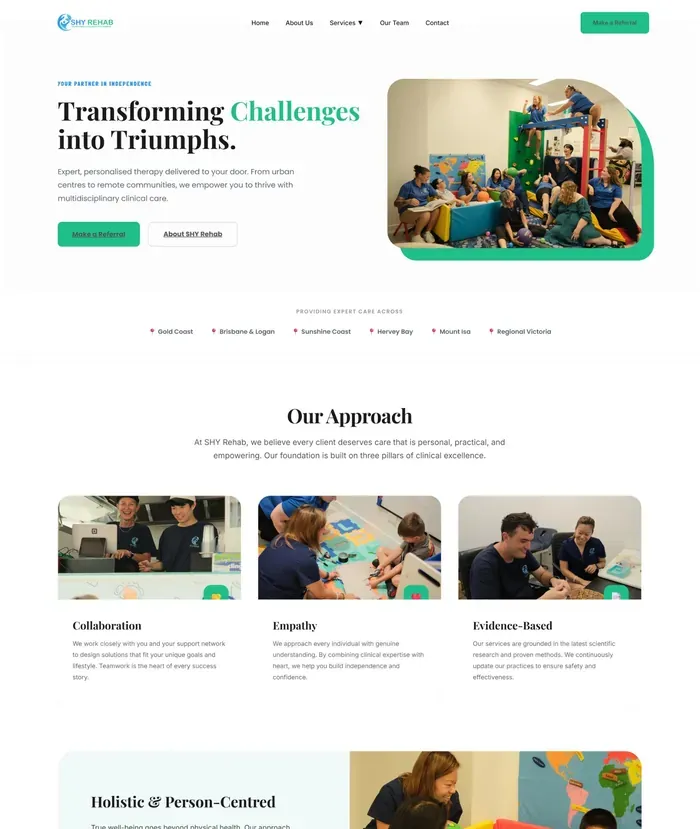
Therapy website with referral system serving 6 Australian locations with holistic care.
View live site: shyrehab.com.auHow we work
Every project follows the same four-phase process. You always know what week you are in, what is being delivered, and what we need from you. Fixed timeline, fixed price, in writing before we start.
DELIVERABLES
We audit your current site for technical SEO, Core Web Vitals, schema gaps, and booking friction. We map keyword targets by procedure and city: Annapolis, Baltimore, Frederick, Bethesda. You receive a written strategy document covering gaps, opportunities, and exactly what we'll build.
DELIVERABLES
We generate your homepage and key procedure pages using AI-assisted design, desktop and mobile, tailored to your practice's positioning. We draft all copy including service page descriptions, physician bios, and FAQs. One consolidated feedback round keeps the project on track.
DELIVERABLES
Approved designs go into WordPress on our performance stack. Every procedure page and location page gets Dentist and MedicalOrganization schema. Your booking platform integrates and is tested across all devices. You get a staging link to review weekly.
DELIVERABLES
We handle DNS cutover, 301 redirect mapping, and sitemap submission to Search Console. Your Google Business Profile and top citation sites are audited and optimized simultaneously. You receive a handoff video and a 30-day post-launch monitoring window.
Most practices are live within 10 weeks of their first call. No retainer required after launch.
Transparent pricing
Every tier is fixed price, fixed scope, fixed timeline, defined in a written statement of work before we invoice a dollar. No hourly billing. No surprise line items for additional revisions. You know exactly what you are buying and when it will be done.
All tiers available with a monthly care plan from $150/month, covering WordPress updates, weekly backups, uptime monitoring, and priority support within 4 business hours.
How we compare
Maryland dental practices have four common website options. The differences in schema control, booking integration, and content ownership determine which one compounds in value over time.
| Factor | Upcoming Brand WordPress | PatientPop / Smile Genius Dental SaaS | Wix / Squarespace Website builder | Generic local agency Template shop |
|---|---|---|---|---|
| Dentist schema control | Full JSON-LD, all fields | Platform-controlled, limited | No custom JSON-LD support | Generic LocalBusiness only |
| Booking platform integration | NexHealth, Zocdoc, Dentrix, Calendly | Limited to platform's own tools | No native dental booking | Varies; rarely tested |
| Code and content ownership | Yours, forever | Platform owns domain/content | You own domain, not code | Yours |
| Monthly cost after launch | $150/month (care plan, optional) | $400 to $1,500/month locked-in | $23 to $65/month platform fee | Varies; $200+/month retainer |
| Core Web Vitals performance | Guaranteed green on delivery | Substandard (platform bloat) | Acceptable but not competitive | Depends on template choice |
| Dedicated procedure pages | One page per procedure, all with schema | Template pages, limited customization | No procedure-specific SEO structure | Varies by agency |
| Local Pack ranking upside | High (schema + GBP + citations) | Moderate (directory authority) | Low (no schema, limited SEO) | Low to moderate |
PatientPop and Smile Genius offer directory listings with real patient acquisition value. That is separate from owning your practice website. Many Maryland dentists do both: a strong owned site plus directory presence.
Complete guide
Everything Maryland dentists and dental practices need to know about building a website that fills appointment slots, ranks in local search, and converts new patient searches into booked chairs.
A dental practice website is not a general healthcare website with a different logo. Whether you are investing in a new dentist website design or rebuilding an underperforming dental office website, the entire strategic architecture, from page structure to schema markup to the copy on the homepage, must be built around one specific goal: converting a new patient search into a booked appointment. That objective is distinct from most other healthcare verticals, and it shapes every decision a skilled dental web designer should make.
Dental searches carry a level of urgency and purchase intent that most service industries never see. When someone searches "dentist near me accepting new patients" or "emergency dentist Baltimore," they are not researching options the way a consumer buying a mattress might browse for weeks. They either have a problem right now (pain, a broken tooth, a dental emergency) or they have finally decided to act on something they have been putting off. Either way, the window between search and decision is short. A dental website that fails to answer three core questions, can you help me, are you near me, and how do I book, within the first few seconds of the visit loses that patient to the next result.
Dental searches differ from general medical searches in one important structural way: they are almost always locally anchored. A patient searching for a cardiologist might look at specialists across a metropolitan region or even consider traveling to a center of excellence. A patient searching for a dentist is looking within a ten-minute drive. This means local SEO is not one part of a dental website design Maryland strategy. It is the foundation everything else is built on.
Schema markup for dental practices requires the Dentist type, which sits within the MedicalOrganization hierarchy in schema.org. Generic LocalBusiness schema is not wrong, but it fails to send the vertical-specific signals that help Google understand your practice category, your accepted insurance, your medical specialty, and the specific services you offer. Dental practices that implement Dentist schema correctly, including openingHoursSpecification, medicalSpecialty, areaServed, and acceptsInsurance fields, have a meaningful advantage in local pack eligibility over competitors who use a generic or incomplete schema type.
Insurance acceptance is one of the most consequential pre-visit decisions a new patient makes. Before calling your office, a significant portion of prospective patients will check whether you accept their insurance carrier. If that information is not clearly visible on your website, you do not just lose the SEO opportunity. You lose the patient. A well-structured insurance page removes friction from the decision cycle and increases the likelihood that a patient who lands on your site actually picks up the phone or clicks the booking button.
Before/after galleries are the single most powerful conversion asset on a dental website, and they are unique to this vertical. In almost no other healthcare specialty can a provider show prospective patients a visual transformation directly attributable to their work. A veneer case, a full-mouth reconstruction, a clear aligner result: these images answer the question "can this dentist actually deliver what I'm hoping for" more convincingly than any testimonial or credential. Practices that invest in professional clinical photography and build well-organized treatment galleries consistently outperform those relying on stock imagery.
Dental practices compete in local search differently than other healthcare verticals because the patient acquisition model is almost entirely proximity-driven and repeat-visit-dependent. The initial new patient acquisition depends heavily on appearing in the local pack, maintaining strong review velocity, and having a high-converting website. That combination of local SEO strength, conversion-optimized site design, and booking accessibility is where dental practices win or lose in their market. Generic healthcare agencies that have not built dental-specific strategies, including proper Dentist schema, dental booking integrations, and treatment-specific landing pages, routinely underdeliver for dental clients because they apply a one-size healthcare template to a practice that requires specialized execution.
A dental practice website is not a brochure. It is an acquisition system, and every page in that system has a specific job to do. Maryland dental practices that treat their website as a passive information display lose new patients to competitors who have built their sites as active conversion tools. The following pages are not optional extras. They are the structural minimum for a dental site that performs.
The homepage must accomplish four things above the fold, before any scrolling: communicate your specialty or differentiator, show your location (city at minimum, neighborhood if relevant), display a phone number that is click-to-call on mobile, and offer a direct path to online booking. Patients landing on a dental homepage after a local search are in a decision-making mode. The homepage must meet them there immediately and not bury the location in the footer or require three clicks to find a phone number.
Individual service pages are not optional, and having a single "services" page that lists everything in one place is a significant SEO and conversion mistake. Each major service category needs its own URL. At minimum, Maryland dental practices should have dedicated pages for general dentistry, cosmetic dentistry, emergency dental care, orthodontics, dental implants, and pediatric dentistry if applicable. Practices that offer orthodontic treatment should treat orthodontist website design as its own discipline, with a dedicated section or subdirectory built around the specific queries patients use when searching for braces, aligners, or retainers. The reason is simple: when a patient searches "dental implants Columbia MD," Google will surface a page dedicated to that topic far more readily than a generic services page where implants are mentioned in a paragraph alongside cleanings and fillings.
Dentist bio pages are underutilized on most dental sites. Patients are making a healthcare decision, not purchasing a commodity. They want to know who will be treating them: their training, their experience, what they specialize in, and something about their approach to patient care. A bio page that goes beyond a three-sentence resume builds trust before the first appointment and distinguishes the practice from competitors who present their doctors as interchangeable service providers.
A dedicated new patient information page reduces pre-appointment anxiety and speeds up office intake. This page should include your patient forms available for download or online completion, your accepted insurance list, directions and parking information, what to expect at a first visit, and answers to the questions new patients most commonly ask before calling. Practices that provide this information online receive better-prepared patients and fewer pre-appointment cancellations.
Each of these pages serves double duty: it informs and reassures prospective patients, and it gives Google additional indexed content to rank for location-specific and treatment-specific queries. Dental practices in competitive Maryland markets, including Baltimore metro, Montgomery County, and Anne Arundel County, cannot afford to leave those ranking opportunities uncaptured.
Schema markup is the structured data layer that sits beneath your website's visible content and communicates directly with search engines in a language they can parse without ambiguity. For dental practices, getting this right means the difference between appearing as a generic local business in search results and being recognized as a credentialed dental provider eligible for enhanced local search features including the local pack, rich results, and knowledge panel data.
The correct schema type for a dental practice is Dentist, which is a subtype of MedicalOrganization in the schema.org hierarchy. Using generic LocalBusiness schema is a common mistake made by agencies that do not specialize in healthcare web design. While LocalBusiness schema is not penalized, it fails to communicate the specificity that Dentist schema provides. Google uses the @type field to determine category eligibility in local search. A practice marked as Dentist is immediately understood as a healthcare provider in a specific medical specialty, which affects which queries and features the listing is eligible for.
The critical fields within Dentist schema that Maryland practices should implement include medicalSpecialty set to "Dentistry," which confirms the provider type to Google's medical knowledge graph. The availableService field should enumerate your major treatment categories as MedicalProcedure entities. The areaServed field should list the Maryland cities and counties your practice draws patients from, not just your office city. openingHoursSpecification should be implemented as structured data rather than only as visible text, because the structured version feeds directly into Google Business Profile data reconciliation.
The priceRange field, while optional, signals to Google the general fee tier of the practice and can influence the type of patient your listing attracts from local search. For practices with clear pricing tiers, such as cosmetic or implant-focused practices, this is worth implementing. The acceptsInsurance field should reference the specific insurance plans you accept using defined vocabulary where available.
Individual dentists in a group practice should be marked up using Physician schema (for MDs and DMDs) or Person schema with jobTitle set to "Dentist" or "Doctor of Dental Surgery" and worksFor referencing the practice's Dentist entity. This creates a relationship graph between the individual providers and the practice that improves how Google represents multi-dentist practices in search.
Schema implementation should be reviewed and updated when practice information changes: new hours, new services, insurance network additions, new providers joining the practice. Stale structured data creates inconsistencies between your schema and your Google Business Profile, which can suppress local pack eligibility. A dental web agency that builds your site should deliver schema as part of the foundational SEO work, not as an afterthought or upsell.
Patient behavior around scheduling has shifted permanently. Research consistently shows that more than 65% of new dental patients prefer to book online rather than call the office, a preference that increases among patients under 45 and those searching on mobile devices. Dental practices that offer only phone scheduling are structurally disadvantaged in new patient acquisition because they require patients to take an extra step that a significant portion of them will skip, especially outside of business hours when the search happens but the office is closed.
The booking integration question is not just a technical decision. It is a practice management decision. Several major platforms serve the dental market, each with different integration characteristics, and the right choice depends on what practice management software the office already uses.
Zocdoc offers a patient-facing marketplace as well as an embeddable widget and is a strong choice for practices that want new patient acquisition from the Zocdoc network in addition to their own site. Weave combines scheduling with communication tools (two-way texting, missed call auto-response, review requests) and offers a booking widget that can be embedded on WordPress sites. Lighthouse 360 is specifically built for dental practices and integrates with Dentrix, Eaglesoft, and other major dental software platforms. NexHealth offers deep two-way sync with practice management software and a clean, mobile-optimized booking interface. Dentrix Ascend and Eaglesoft both offer native web booking extensions that integrate tightly with the software if your practice already uses those systems.
From a technical implementation standpoint, booking widget embeds must be handled carefully on WordPress sites. Third-party scripts loaded directly in the page body can severely impact Core Web Vitals scores, particularly Largest Contentful Paint and Total Blocking Time. The recommended approach is to implement booking widgets as lightweight facades: a styled button or inline placeholder that loads the full booking interface only when the user interacts with it. This keeps initial page load fast while still providing immediate booking access.
The ROI calculation for online booking implementation is clear: if your practice sees 30 new patients per month at an average lifetime patient value of $2,000, and an online booking system increases new patient acquisition by 20%, that is 6 additional patients per month, adding $12,000 in lifetime patient value monthly from a system that costs a few hundred dollars. The question is not whether to implement online booking. The question is which platform integrates cleanest with your practice management software and your WordPress site.
Ask any dental front desk coordinator what the single most common question from new patient callers is, and the answer is almost always some variation of: "Do you take my insurance?" This question is the primary gating decision for a significant portion of dental patients, and if your website cannot answer it before the patient picks up the phone, you are losing patients at the earliest stage of the funnel, the research phase, before any human contact has occurred.
A well-structured insurance accepted page is one of the highest-ROI pages on a dental website, and it is chronically underdeveloped on most practice sites. The page should open with a clear affirmative statement, not "we work with many insurance providers," but a specific list of every carrier and plan you accept. Maryland dental patients commonly carry Delta Dental (including Delta Dental of Virginia and Delta Dental of Pennsylvania plans, both active in the Maryland market), CareFirst BlueCross BlueShield, Cigna Dental, Aetna Dental, MetLife, United Concordia, Humana, and Maryland Medicaid through the MCO plans. Each of these should be listed explicitly, not buried in a general statement.
For out-of-network patients, the page should explain clearly what that means in practical terms: the patient pays at time of service, you provide a superbill they can submit to their insurer for reimbursement, and you can give an estimate of likely out-of-pocket costs for common procedures. Practices that explain the out-of-network process professionally convert a higher percentage of out-of-network patients than those that simply say "we are not in-network with your plan" and let the conversation end there.
Financing options deserve their own section on the page, presented in a way that reduces the psychological barrier without sounding transactional. CareCredit is the most widely recognized dental financing option and should be presented with the specific terms available at your practice (12-month no-interest if paid in full is the standard promotional offer). Sunbit is gaining traction as a patient-friendly alternative with a simpler approval process and higher approval rates for patients with imperfect credit. In-house payment plans, if your practice offers them, should be described clearly: what the terms are, what treatments they apply to, and how to ask about them.
The insurance and financing page is also an SEO asset. Queries like "dentist that takes Delta Dental near me" and "CareCredit dentist Baltimore" represent real search volume from high-intent patients. A dedicated, well-structured page targeting these queries can rank for them and deliver patients who have already passed the insurance verification hurdle before they even contact the office.
No piece of content on a dental website does more conversion work than a high-quality before/after gallery. This is the only healthcare specialty where the provider can show prospective patients a direct visual demonstration of clinical outcomes, a veneer smile transformation, a clear aligner case, a full-arch implant reconstruction, and that visual proof answers the patient's core question ("can this dentist actually do what I'm hoping for?") more completely than any combination of credentials, testimonials, or written descriptions.
Before publishing any patient photograph, practices must have written authorization from the patient that specifically covers the use of their image on the practice website. A general treatment consent form is not sufficient. The photography release should specify that images may be used in digital marketing, name the specific platform (website), and be retained in the patient's file indefinitely. Practices should consult with their malpractice insurance carrier and attorney to ensure their release language complies with Maryland and HIPAA requirements. When in doubt, publish without any identifying information: cropped to the smile only, with no name or identifiable context in the caption or alt text.
Clinical photography standards matter. Smartphone photos taken under operatory lighting do not build confidence; they undermine it. Consistent retraction technique, standard camera distance, neutral gray background when possible, and consistent lighting make the transformation visible and professional. The investment in a clinical photography protocol pays for itself in conversion rate improvements on the gallery page alone.
Gallery organization should follow treatment type rather than date order. Patients searching for veneer results want to see veneer cases, not a mixed chronological feed of every case the practice has documented. Separate galleries for veneers and smile makeovers, teeth whitening, dental implants and implant-supported bridges, Invisalign and clear aligner cases, and full-mouth reconstruction allow each gallery to function as a treatment-specific landing page that can rank for queries like "veneer results Columbia MD" or "dental implant before after Annapolis."
Practices that invest in building a genuine, well-organized, professionally photographed gallery consistently see higher time-on-site metrics for gallery pages, higher contact form completion rates from visitors who viewed the gallery, and stronger new patient acquisition for high-value cosmetic treatments where the visual proof is most critical to the purchase decision.
Local search is where dental patient acquisition happens. The majority of new dental patient searches are variations on "dentist near me," "dentist [city name]," "emergency dentist [city name]," or "[specific treatment] dentist [city name]." Every one of those queries has local intent, and Google's response to local intent queries is the Google Local Pack, the map-based three-result cluster that appears at the top of the search results page and captures a disproportionate share of clicks. Getting your practice into the local pack, and keeping it there, is the central objective of dental SEO and dentist SEO for Maryland practices. Effective dental local SEO combines on-site optimization, Google Business Profile management, and citation consistency into a system that keeps your practice visible when patients are actively searching.
Google Business Profile is the most important single asset in local SEO for dental practices, more impactful than any on-site optimization alone. Your GBP category should be set to "Dentist" as the primary category, with relevant secondary categories (Dental Clinic, Cosmetic Dentist, Pediatric Dentist, Orthodontist, etc.) added based on your actual specialties. Key attributes to enable include "Accepts new patients," "Wheelchair accessible entrance," and "Online appointments" if you have booking enabled. Hours must be current and match your website exactly; inconsistencies between GBP hours and website hours are a trust signal degradation to Google.
Citation consistency is the foundational requirement of dental local SEO. Your practice name, address, and phone number must be identical across every directory listing: Healthgrades, ZocDoc, Yelp, 1-800-Dentist, Vitals, US News Health, Yellowpages, and the dozens of secondary directories that aggregate healthcare provider information. Inconsistencies, even small ones like "St." vs. "Street" or suite number formatting, create signals that the NAP data is unreliable, which suppresses local pack eligibility.
Patient reviews are a confirmed local ranking signal and a primary conversion factor for new patients reading your listing. Practices should implement a systematic review request process. A text message sent 24 hours after each appointment with a direct link to the Google review form is the highest-completion approach. When responding to negative reviews, respond calmly and professionally without disclosing any patient-specific information (HIPAA applies to review responses), and use the response to demonstrate how you handle concerns rather than to argue with the reviewer.
Maryland's dental market is competitive in the Baltimore-Washington corridor, with practices in Columbia, Rockville, Annapolis, Towson, and Bethesda competing for patients in overlapping service areas. Practices that invest consistently in GBP optimization, citation hygiene, review velocity, and on-site local SEO maintain local pack visibility. Practices that treat local SEO as a one-time setup task lose ground steadily to competitors who treat it as an ongoing discipline.
"Emergency dentist near me" is the highest-converting search query in dental. The person typing that search has pain, urgency, and a clear decision already made: they need a dentist today. They are not comparing options across weeks or reading blog posts about oral health. They are looking for a phone number and same-day availability right now. Capturing this traffic requires a dedicated emergency dental page built specifically around that intent, not a paragraph buried in a general services page.
The emergency dental page must prioritize the phone number above everything else. On mobile, where the majority of emergency dental searches happen, the phone number should be a tap-to-call link positioned within the first visible screen, before any scrolling. A same-day or after-hours availability statement should appear alongside the phone number: "We offer same-day emergency appointments for existing and new patients. Call now." If your practice has extended hours or a dedicated emergency line, those details belong at the very top of the page, not in the body copy below the fold.
The page should explain clearly what qualifies as a dental emergency, such as a broken or cracked tooth, severe toothache, lost crown or filling, dental abscess, tooth knocked out, or injured jaw, and what the patient should do while waiting for their appointment. For a knocked-out tooth, for example, the guidance to keep the tooth moist in milk or saliva and see a dentist within an hour is clinically important and demonstrates clinical credibility to the reader. This type of content also improves the page's topical authority for emergency-related queries.
Emergency dental pages need their own URL at /emergency-dentist/ or /emergency-dental-care/, rather than being a section on the homepage or a subsection of a services page. Google ranks pages, not sections. A dedicated URL can accumulate keyword relevance, backlinks, and click-through signals independently. A section buried in a longer page cannot compete for "emergency dentist [city]" queries the way a standalone, optimized page can.
Practices that invest in a well-built emergency dental page consistently report it as one of their top-performing pages by both traffic and conversion rate. The searcher intent is as high as it gets in dental. The page's job is simply to not lose that patient with friction, slow loading, or a buried phone number.
Pediatric dental searches are made by parents, not by patients. That fundamental difference shapes everything about how a pediatric dental website should be designed, what content it should prioritize, and what emotional register its copy should strike. A parent searching "pediatric dentist near me" is not just evaluating clinical credentials. They are asking whether this practice will be patient with my anxious child, whether the office will feel welcoming and not frightening, and whether the dentists and hygienists here have real experience working with kids at different developmental stages.
Parent search behavior for pediatric dental care differs from adult dental searches in one key way: it tends to involve more research. Parents are more likely to read the About page, look at office photos, and read reviews specifically mentioning children before making contact. This means the content investment on a pediatric dental site pays off more directly than on a general dental site. Parents who do the research and choose your practice based on what they found online are more committed patients with lower no-show rates.
The visual presentation of a pediatric dental website must work hard. Photos of the actual office, the waiting room, the operatories, the staff interacting with young patients, are among the most powerful trust builders on a pediatric site. Parents want to mentally walk their child through the visit before it happens. Stock photos of generic dental offices do not accomplish this. If the office has colorful murals, a themed waiting area, or child-sized furniture, those details belong prominently on the homepage and the dedicated pediatric page.
Copy should address both the parent's practical concerns and their emotional concerns. Practically: when should my child first see a dentist, do you treat children with dental anxiety, what does a cleaning involve at this age, do you offer sedation dentistry for kids, what happens if my child needs a filling. Emotionally: we understand that bringing a nervous child to the dentist is stressful, our team is trained to work at your child's pace, we will never rush or force a procedure a child is not ready for.
Maryland pediatric dental practices serving the Baltimore suburbs, Montgomery County, and the DC metropolitan corridor are competing with both general dentists who see children and specialized pediatric practices. The practices that win the parent research process are those whose websites communicate clinical competence and genuine child-centeredness in equal measure, not one at the expense of the other.
Cosmetic dental patients represent the highest-value acquisition opportunity in the dental market, and they also have the longest consideration cycle of any dental patient type. A patient searching for a dentist because of tooth pain will book within hours. A patient considering veneers or a full smile makeover may research for weeks or months, visit multiple practice websites, read reviews, watch procedure videos, and compare before/after galleries across several providers before making contact. The cosmetic dental website must be built to support and win that extended research process.
Cosmetic dental searches differ structurally from general dental searches in search intent and query specificity. General dentistry searches are proximity-driven ("dentist near me"). Cosmetic searches are procedure-specific and less strictly proximity-bound. A patient in Howard County might drive to Baltimore or DC for a veneer provider with exceptional case documentation. This means cosmetic dental pages can rank and convert patients from a broader geographic radius than general dental service pages, but they must demonstrate clinical excellence at the level those patients are evaluating.
What cosmetic dental patients look at before booking is predictable and consistent: before/after gallery quality is the primary evaluation criterion, not just the number of cases shown but the quality of the photography and the caliber of the outcomes; doctor credentials including where they trained in cosmetic dentistry, any post-doctoral cosmetic training, and aesthetic dentistry society memberships; and pricing transparency or at least financing options that make it possible to understand the investment range before committing to a consultation.
Service pages for cosmetic procedures must be built with the extended consideration cycle in mind. A veneers page should explain the full treatment process, what candidacy looks like, how long results last, how the teeth are prepared, and what maintenance involves, not just a paragraph saying "we offer porcelain veneers." Similarly for dental implants (the research cycle for implants can extend for a year or more), Invisalign, teeth whitening, and smile makeovers. The more fully your page answers the research questions, the more likely it is that a patient completes their research on your site rather than leaving to find the answers elsewhere.
Cosmetic dental practices in Maryland competing for patients in the Baltimore-Washington corridor are operating in one of the most affluent and competitive cosmetic dental markets in the country. Effective dental practice marketing at this tier is not about outspending competitors on ads. It is about building a website with the content depth, case documentation, and technical performance that earns the trust of a patient who may visit the site five times before picking up the phone.
Dental websites are consistently among the worst-performing healthcare sites in terms of technical web performance, and the reasons are predictable: photo galleries with unoptimized high-resolution images, multiple third-party booking and chat widgets loaded synchronously, outdated WordPress installs running bloated page builders with accumulated plugin debt, and sites built by dental-specific SaaS companies on proprietary platforms that prioritize template convenience over performance optimization. The result is dental sites that score in the 20s and 30s on Google's PageSpeed Insights while their potential patients bounce because the page took six seconds to load on a 4G connection.
Core Web Vitals are Google's performance measurement framework and a confirmed ranking signal. For dental sites, the benchmarks that matter most are Largest Contentful Paint (LCP) under 2.5 seconds, Cumulative Layout Shift (CLS) under 0.1, and Interaction to Next Paint (INP) under 200 milliseconds. The LCP benchmark is the most commonly failed on dental sites because the hero image, a large banner photo of the office or a smile, is the LCP element, and unoptimized hero images are the single most common cause of dental site performance failure.
Auditing a dental site's performance starts with Google's PageSpeed Insights using a mobile simulation, which is the benchmark Google actually uses for ranking. Common findings on poorly performing dental sites include render-blocking JavaScript from booking widgets and chat tools, images served in legacy formats (JPEG, PNG) rather than modern formats (WebP, AVIF), missing width and height attributes causing layout shifts, no server-side caching, no CDN delivery, and WordPress running dozens of active plugins with redundant functionality.
A properly architected dental WordPress site uses a lightweight theme framework (Astra or GeneratePress are the current standards for performance-first builds), a mature page builder like Elementor Pro configured for performance mode, WP Rocket or LiteSpeed Cache for server-side caching, and Cloudflare for CDN delivery and edge caching. Images are converted to WebP at upload using a plugin like ShortPixel or Imagify. Third-party scripts (booking widgets, chat tools, analytics) are loaded with defer or async attributes and, where possible, implemented as facades.
Technical SEO for dental sites also includes crawlability fundamentals: a clean sitemap submitted to Google Search Console, proper canonical tags preventing duplicate content issues on service-area pages, hreflang tags if serving Spanish-speaking patient populations (a significant demographic consideration in many Maryland markets), and a robots.txt file that is not accidentally blocking critical pages from indexing, a surprisingly common error on sites migrated from SaaS platforms to WordPress.
Choosing a web design agency for your dental practice is a business decision with long consequences. The agency you hire will build the system that determines how many new patients find your practice, whether they trust what they find, and whether they convert into booked appointments. A poor agency choice does not just result in a website you dislike. It results in a website that fails to rank, fails to convert, and locks you into a platform or contract that makes switching expensive.
The questions you should ask a web design agency before signing a contract are specific and non-negotiable. Do they know Dentist schema, not just LocalBusiness schema, but the specific Dentist type with medicalSpecialty, availableService, and acceptsInsurance fields? Have they built dental sites specifically, and can they show you live examples with traffic data? Can they integrate with your practice management software for online booking, and do they know the difference between a Dentrix integration and a Zocdoc embed? How do they handle HIPAA considerations for contact forms and booking data, and if they do not have a clear answer, that is a significant red flag for a healthcare context.
Red flags in a dental agency evaluation are predictable. Any agency that guarantees first-page rankings or a specific position in the local pack is making a promise that is not within their control to keep. Google's local algorithm is not a contract. Agencies with no dental portfolio asking you to be their first dental client are not a risk worth taking when patient acquisition is at stake. Hourly billing without a project cap creates budget uncertainty on a project that should have a defined scope and a fixed price. Multi-year contracts with significant exit penalties are a structure that benefits the agency, not the practice. A good agency earns continued engagement through results, not contractual lock-in.
What a dental website project should include at minimum: a discovery phase covering your practice, your patient demographics, your competitive landscape, and your goals; custom design (not a recycled template with your logo swapped in); mobile-first development with Core Web Vitals optimization; Dentist schema implementation; booking integration with your practice management software; on-page SEO for all primary service pages and location pages; Google Business Profile optimization; and a post-launch support plan that covers security updates, plugin maintenance, and performance monitoring.
The right dental web design agency is one that treats your website as a business asset rather than a design project: one that understands local search, dental-specific schema, booking integrations, conversion optimization, and the specific patient acquisition dynamics of your Maryland market. That combination of technical capability, dental industry knowledge, and local market understanding is what distinguishes agencies that deliver measurable new patient growth from those that deliver attractive sites that underperform in search.
Every build includes
No add-on fees for the fundamentals. Every dental website design project ships with the complete stack at one fixed price.
Transparent pricing
A custom WordPress website for a Maryland dental practice costs between $1,500 and $6,000 for most single-location practices. Multi-location and specialty builds start at $6,000. Every quote is fixed-scope - one price, no hourly surprises.
Need to spread the cost? Use our payment plan calculator. Full pricing breakdown →
For local searches in smaller Maryland markets, practices see movement in 60 to 90 days. Competitive markets like Baltimore take 3 to 6 months for consistent first-page presence. Google Business Profile and Local Pack optimization show results fastest, with improvement appearing within 30 to 45 days of launch.
We integrate with NexHealth, Dentrix Online Booking, Zocdoc, Open Dental's web scheduling, and Calendly. We connect whichever platform you already use or help you select one if you don't have a preference. The goal is patients booking without calling, not adding another software subscription.
We write all copy as part of every project tier. You provide raw material via a questionnaire: procedures offered, areas of focus, doctor credentials, and any before/after cases you want highlighted. We draft procedure descriptions, doctor bios, and patient FAQs. One review round included.
Not with proper migration planning. We map every existing URL to its new equivalent and implement 301 redirects before DNS cutover. Clean migrations with full redirect maps recover within 4 to 6 weeks. We monitor Search Console for 30 days post-launch and resolve any crawl errors that appear.
Our WordPress maintenance plans start at $150/month covering WordPress updates, weekly backups, uptime monitoring, and priority support with a 4-business-hour response window. We also offer a content add-on, one new procedure page or location landing page per month, that compounds your SEO footprint. Month-to-month, no annual contract.
This is exactly what the Growth and Custom tiers are designed for. We build dedicated procedure pages and city landing pages for each Maryland market you serve. Each page targets specific queries like "dental implants Annapolis" or "orthodontist Baltimore" with correct schema, targeted copy, and internal linking structure.
WordPress is the stronger platform for dental practices competing in local search. Wix and Squarespace cap your PageSpeed at 50 to 70 and limit the structured data you can implement, both hurt Local Pack rankings. A custom WordPress build gives you full Dentist and MedicalOrganization schema control, a PageSpeed score above 90, and Core Web Vitals in the green before launch. If you plan to rank for competitive terms like "dentist [city]" against established practices, the platform gap becomes a ranking gap.
Dental websites · Maryland
★★★★★ 5.0 on Google · 99% Job Success on Upwork
30 minutes · We review your site, your market, and tell you exactly what we'd build and what it costs.