
AI SEO Tools in 2026: The 5 Categories That Matter
AI SEO tools by category: visibility trackers, schema and entity tools, content optimizers, and llms.txt generators. Which to pay for and which to skip.
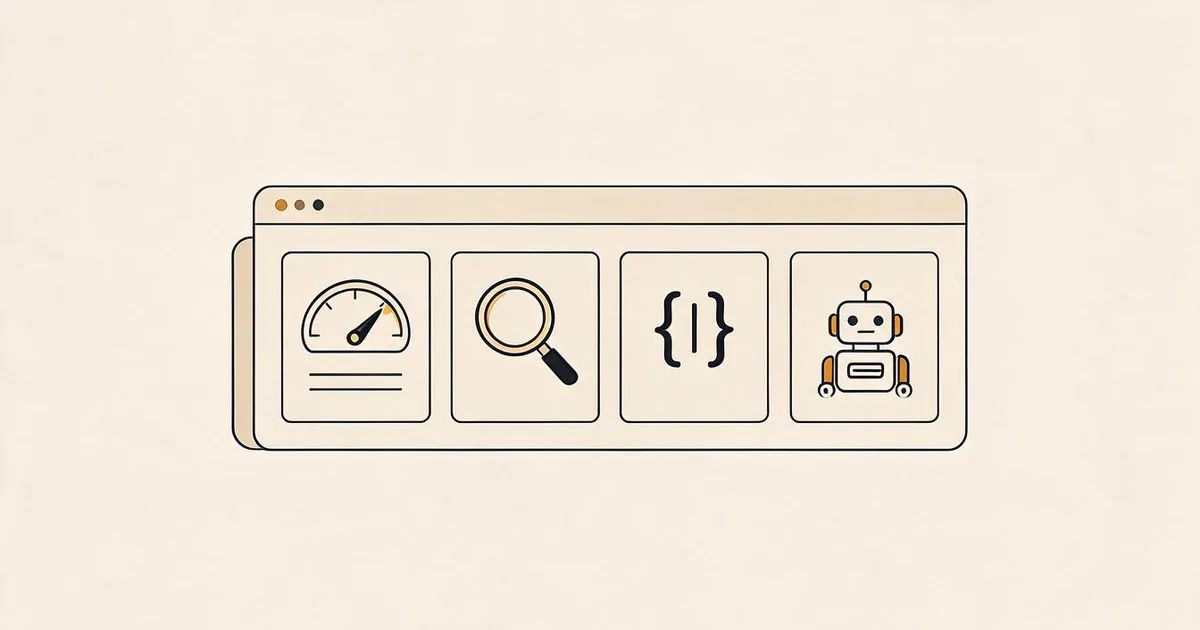
- AI SEO tools fall into five categories: AI visibility trackers, schema and entity tools, content optimizers, llms.txt generators, and AI-assisted classic SEO tools.
- The highest-impact work, schema, llms.txt, entity signals, and answer-first content, can be done with free tools. Paid trackers report on citations; they don't create them.
- There's no single best AI SEO tool, because the job has distinct parts. The tool matters far less than doing the entity, schema, and formatting work at all.
- For most small businesses, the free layer plus one focused AI visibility tracker covers everything worth paying for.
What do AI SEO tools actually do?
AI SEO tools help you get your brand visible and cited inside AI-generated answers on ChatGPT, Perplexity, Gemini, and Google AI Overviews. Some track whether AI mentions you, some make your site machine-readable, and some help format content so engines can extract it. A few use AI to speed up classic SEO tasks like keyword research and content briefs, which is a different thing wearing the same label.
That last distinction trips people up. "AI SEO tools" means two things in the market: tools that help you rank in AI answers (the real shift), and classic SEO tools that added an AI feature. This guide focuses on the first group, the tools that matter for AI SEO, and flags the overlap where it helps.
What are the five categories of AI SEO tools?
AI SEO tools sort cleanly into five groups, each doing a different part of the job. Knowing the categories matters more than any brand name, because you buy by the gap you're filling.
- AI visibility trackers check whether ChatGPT, Perplexity, and AI Overviews cite you, and who they cite instead.
- Schema and entity tools generate the structured data and entity signals that make your brand identifiable to models.
- Content optimizers score and reshape pages for extraction: answer capsules, question headings, quotable structure.
- llms.txt generators create the file AI crawlers read the way search bots read a sitemap.
- AI-assisted classic SEO tools speed up keyword research, briefs, and drafts, useful, but not AI-answer optimization by themselves.
What do AI visibility tracking tools do?
AI visibility trackers run your target questions through the AI platforms on a schedule and record whether your brand appears, gets cited with a link, or is absent. They're the measurement layer of AI SEO, and the one category worth paying for once you have a baseline.
The good ones let you define a fixed prompt panel, track it across ChatGPT, Perplexity, Gemini, and Google AI Overviews, and show change over time plus which competitors hold the citations you want. That's the same prompt-panel method a proper generative engine optimization engagement uses, just automated. The trap: a tracker tells you AI ignores you, but not why. It won't diagnose missing entity schema or unextractable content, which is where the actual fixing happens.

What about schema and entity tools?
Schema and entity tools generate the structured data that makes your brand machine-readable, which is the foundation everything else sits on. A model can only cite a brand it can identify, and schema is how you tell it who you are.
The essentials are free. A clean JSON-LD generator that outputs valid Organization, Person, FAQ, and HowTo markup beats any bloated all-in-one suite, because correctness matters more than volume here. Our free schema generator does exactly this, and for entity signals the work is manual anyway: consistent naming, sameAs links to LinkedIn and Wikidata, and a real About page. No tool automates the entity layer for you, it just formats what you feed it.
Do content optimization tools help with AI SEO?
Content optimizers help by scoring pages for extractability and flagging where answers are buried, but the real work is structural, not something a score fixes for you. They're an assist, not an answer.
The useful ones check whether your target questions have direct answer capsules, whether headings match how people ask, and whether lists and tables exist where a query calls for them, the raw material of answer engine optimization. But a score of 85 doesn't write the 40 to 60 word answer or restructure the rambling section. The tool points; a person fixes. Treat content optimizers as a checklist, not a ghostwriter, and they earn their place.
One caution worth naming: some content tools now offer to generate whole articles for AI SEO. Be careful there. Thin, model-written pages with no first-party data are exactly what generative engines skip, because they can already produce that text themselves and have no reason to cite it. The content that gets quoted has something a model can't generate on its own: your prices, your process, your results, your original take. A tool that helps you structure that is worth using; one that replaces it with generic filler quietly works against you.
Which AI SEO tools can you start with for free?
Everything that matters most is free to start. Before spending a dollar on a tracker, these cover the highest-impact work:
- A schema generator for valid Organization, FAQ, and HowTo JSON-LD, like our free schema generator.
- Manual prompt checks, just ask ChatGPT and Perplexity your buyer questions yourself and note who they cite. That's a free baseline.
- An llms.txt generator to create the crawler file; several free ones exist, and a WordPress site can ship it as a static file.
- Google Search Console to catch the impressions-up-clicks-flat pattern that signals AI answers are absorbing your traffic.
Run those first. They tell you whether you have an AI visibility problem worth paying to track, before you pay to track it.
How do you pick the right AI SEO tools?
Buy by the gap, not by the roundup. Start free, find where you actually stand, then add one paid tool for the one job the free layer can't do, usually automated visibility tracking.
The mistake is buying an expensive all-in-one suite before you know your baseline, then using ten percent of it. The honest sequence: generate your schema, ship llms.txt, run manual prompt checks, and see if AI cites you. If it doesn't and you can't tell why, that's the point where a specialist beats another tool. Our AI SEO service starts with a $750 audit that does exactly that diagnosis, then implements the fixes tools only measure. Tools are the input; the work is the output.
It helps to match the tool to the business stage. A brand-new site doesn't need a paid tracker yet, it needs schema, llms.txt, and a handful of quotable pages, all free to build. A growing business with content already ranking is the right moment to add a visibility tracker, because now there's a baseline to move and competitors to watch. And a business that has run the free layer, added a tracker, and still can't get cited has a diagnosis problem, not a tooling problem, which is where the audit pays for itself. Buying in that order means every dollar you spend on a tool answers a question the previous step actually raised.
Tried the tools and still invisible to AI?
Free 45-minute call. We'll tell you whether it's a schema gap, an entity gap, or a content gap, the diagnosis no tracker gives you. No pitch.
Frequently asked questions about AI SEO tools
What are AI SEO tools?
AI SEO tools help you get your brand visible inside AI-generated answers on ChatGPT, Perplexity, Gemini, and Google AI Overviews. They fall into a few groups: visibility trackers that check whether AI cites you, schema and entity tools that make your site machine-readable, content optimizers that format pages for extraction, and llms.txt generators. Some also use AI to speed up classic SEO tasks like keyword research and briefs.
Do I need paid AI SEO tools to rank in AI answers?
No. The highest-impact work, clean schema, an llms.txt file, consistent entity signals, and answer-first content, can be done with free tools and a normal WordPress site. Paid trackers are useful once you have a baseline to measure and a budget to defend, but they don't create citations, they just report on them. Start free, prove the concept, then decide whether a paid tracker earns its subscription.
What is the best AI SEO tool in 2026?
There isn't a single best tool, because the job has distinct parts. For AI visibility tracking, dedicated prompt-monitoring tools lead. For schema, a clean JSON-LD generator matters more than any all-in-one suite. For content, the best tool is a structure your writers actually follow. The honest answer most roundups avoid: the tool matters less than doing the entity, schema, and formatting work at all, which most sites still skip.
Can AI SEO tools replace an agency or a specialist?
Tools report and assist; they don't decide strategy or fix root causes. A visibility tracker tells you AI ignores you, but not that your entity schema is missing or your content can't be extracted. That diagnosis and the implementation are the work an agency or specialist does. Tools make that work faster and measurable, which is why we use them, but they're an input to the job, not the job itself.
How much do AI SEO tools cost?
Free for the essentials: schema generators, llms.txt creation, and manual prompt checks cost nothing. Dedicated AI visibility trackers typically run $30 to $200 a month depending on the number of prompts and platforms tracked. All-in-one AI SEO suites can run higher. For most small businesses, the free layer plus one focused tracker covers everything worth paying for.
Upcoming Brand | AI search optimization for US businesses, Maryland-based
We help businesses across Baltimore, Annapolis, Frederick, and the US get cited in AI answers, using the right tools plus the work tools can't do, delivered remotely via Zoom and async reporting. Every engagement starts with a $750 AI visibility audit and a prioritized fix list, with implementation from $2,500 on WordPress sites. Book a free discovery call or email hello@upcomingbrand.com.
Want the work, not just the tools?
AI SEO from $750: prompt-panel audit, schema, llms.txt, entity mapping, and answer formatting. The fixes tools only measure, done for you.